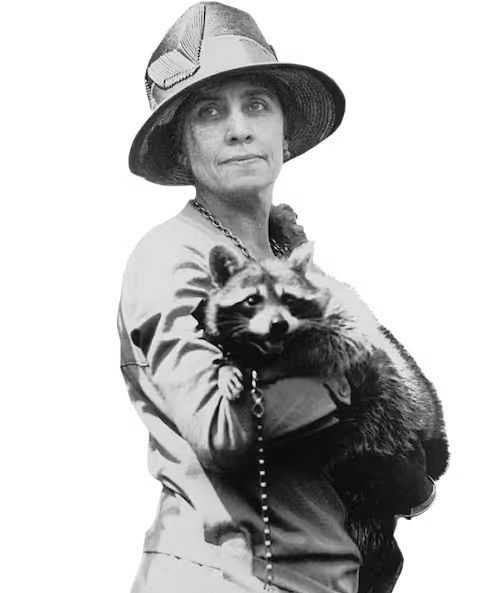
A more than 100-year-old snapshot captured a slightly blurred Florence Kling Harding gazing down through her spectacles as she stood before what appeared to be two locked ballot boxes. In sharp focus, in the background, was a closely gathered group of mostly men watching her as she turned in her ballot. Over her shoulder, her husband Warren G. Harding, one of two presidential nominees hailing from Ohio and vying for the highest office of the land, also watched as she was photographed on November 2, 1920, Election Day.
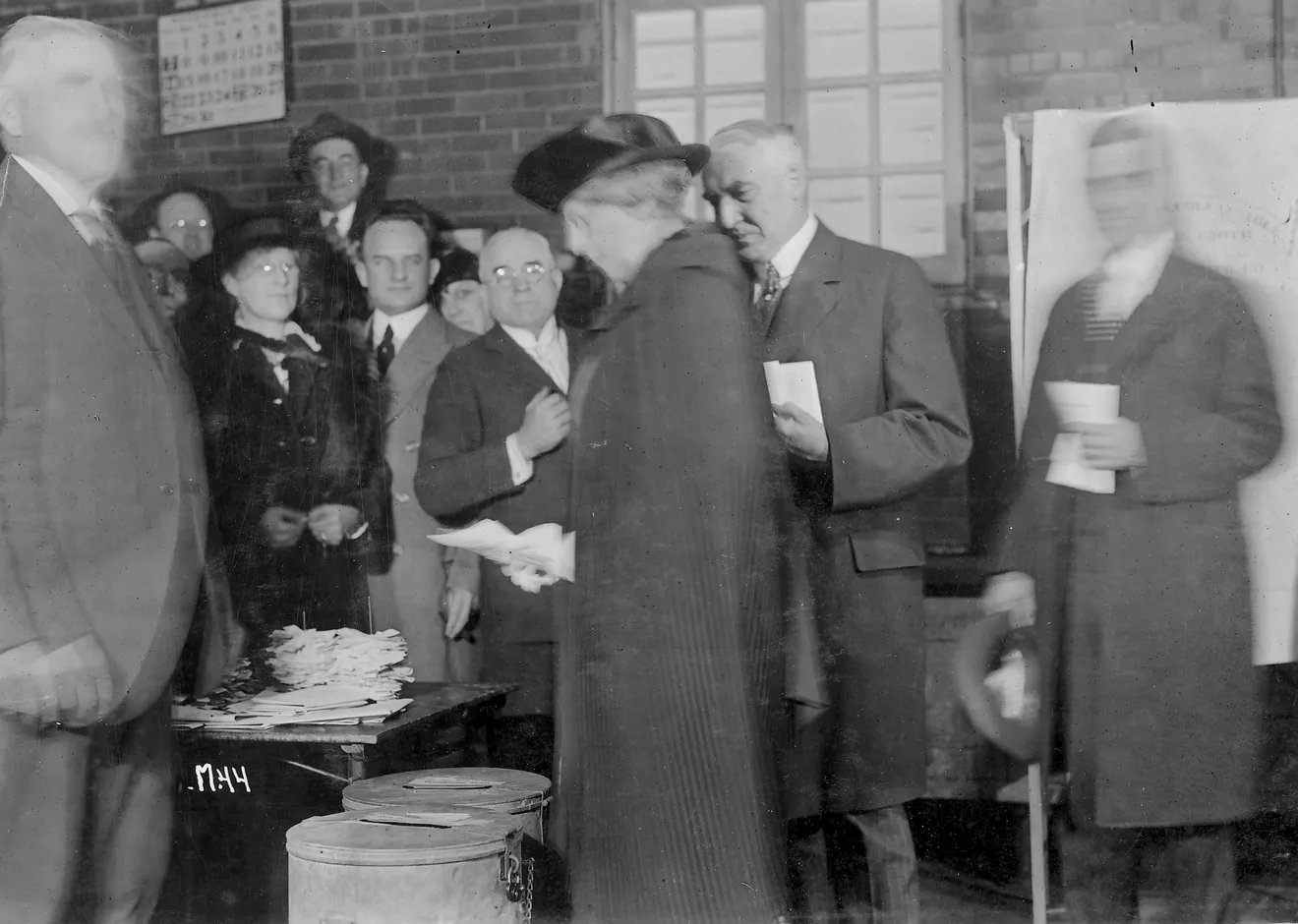
It was a landmark moment: the first presidential election held in the United States after the ratification of the Nineteenth Amendment, granting women the right to vote. Mr. Harding won in a landslide. But, that somewhat imperfect image showing Florence Harding becoming the first future first lady to vote gave women across the country a visible symbol and a powerful message about the legitimacy of women participating in the political process.
The first lady was seen. And, in turn, women were seen.
That visibility became trademark for Florence Harding and extended throughout her short yet impactful time serving as first lady of the United States from 1921 to 1923. Today, when women head to the polls, it was her visibility, in part, that allowed women to envision themselves playing a larger, more impactful role in society.
Florence Harding was an unwavering supporter of women’s rights. Her husband’s sweeping victory also marked a triumph for the incoming first lady who, at sixty years old and with the wind of the emerging “Modern Woman” era at her back, would seize the politically open landscape to help women gain a footing at the start of a transformational decade.
Immediately, Florence Harding turned the White House from what historians described as a “fortress” into a destination. She gave citizens more access and hosted the first White House Easter Egg Roll since the beginning of World War I. And on any given day the Hardings received 1,000 or more people through marathon handshaking receptions.
A savvy newspaperwoman herself, the first lady understood the power imagery could have on the public. Historians credit Mrs. Harding with creating the modern day “photo op.” She welcomed and engaged with the press, even while declining interviews. She hosted women’s political groups, female federal workers, and distinguished visitors such as scientist Marie Curie, along with young women graduating from high school and college, including African American girls from the local Dunbar High School. She also broke “an unwritten social code” by inviting divorced women to social events.
Yet, as first lady, Florence Harding believed her role went beyond White House hostess. She felt it was her duty to help women understand their government and discover their political agency. Inside the White House, Mrs. Harding was influential in filling government appointments, ensuring that some positions were filled by women. Even before the inauguration, the president-elect directed potential appointees to send information to him through Mrs. Harding. One appointment filled by a woman drew controversy, but a newspaper defended the decision by saying, “When people elect a president, they at the same time elect a presidentess.”
Florence Harding recognized suffrage led to a moment when women could become more visible, active, and heard. And, she took advantage of it.
When the first lady considered the changing role of women in society, she encouraged women to engage in physical fitness. To the Camp Fire Girls she wrote: “The part that women play in the world has been greatly changed. … It has been broadened and enlarged and we will be wise to recognize that a larger consideration for the health and physical advancement of girls will better fit them for the role they must assume.”
“The part that women play in the world has been greatly changed…broadened and enlarged.”
- Florence Harding
When the price of sugar skyrocketed, she led a national boycott and wrote of women who stay home that they “are the makers of the household budget, the managers of the homes, which, in the final analysis, are the end and aim of organized society.”
When outspoken suffragists were incarcerated alongside men under harsh conditions, Florence Harding shared a humanitarian vision and joined women’s groups in advocating for the creation of a federal prison exclusively for women. It was the first time Mrs. Harding actively tried to influence policy. Though the reform-minded institution was not realized during her time as first lady, her advocacy helped lay the groundwork for Alderson Federal Prison Camp, established in West Virginia in 1927 – three years after her death – and later championed by future First Lady Eleanor Roosevelt. The prison still operates today.
When wounded American military veterans settled back into society two years after the end of World War I, Florence Harding honored and advocated for them. She hosted large parties at the White House and visited hospital wards, sitting with men suffering from mental trauma, tuberculosis, blindness, or missing limbs. When appropriate, she intervened on behalf of veterans to right certain injustices. And, Mrs. Harding led a national effort to create a World War I monument to soldiers on the National Mall.
When it came to the humane treatment of animals, Florence Harding believed supporting animal welfare was an imperative part of a civil society. “Cruelty begets cruelty,” she once wrote, explaining how “hardness towards animals is certain to breed hardness towards our fellow man.”
And when Florence Harding became deathly ill with nephritis, a kidney affliction, two years after entering the White House, she opened up about it. She wanted citizens to know – with doctors and journalists watching closely – that although sequestered, she was still very much there. She believed illness wasn’t something to hide, rather a natural part of life. In fact, part of what kept her alive during that trying time, writes biographer Katherine Sibley, was the combined prayers of the entire country – prayers that had been encouraged by the administration’s own openness.
In the summer of 1923, a recovered Florence Harding embarked with her husband on an epic trans-continental trip to Alaska that would return through the Panama Canal, stop in the Caribbean, and end in New York City. But the journey was cut short. After the couple’s appearance in Alaska, the president became gravely ill. The train hurried straight to San Francisco where the president was treated, but tragically died on August 2, 1923.
The remainder of the first lady’s time was overshadowed by her husband’s funeral, an administration in transition, and the unfolding Teapot Dome scandal exposing government corruption, resulting in the conviction of the first cabinet member in U.S. history to go to prison, leaving a stain on Warren Harding’s presidency.
.jpg)
In 1924, Florence Harding was photographed at a Connecticut high school named for her late husband. Surrounded by men, she is seated, dressed in dark clothes and holding a bouquet of flowers in her lap. With her head turned slightly, she gazes through her spectacles making eye contact with the camera, staring back at the arc of history.
A century later with more Harding papers released and growing interests in the historical impact of women, scholars have pieced together a clearer image of this first lady.
And, it looks like this:
Florence Kling Harding believed women were not simply adjuncts of their husbands. She believed women are people with agency. She believed women should understand how the government works. She believed women should engage in the political process. And, she encouraged women to think about their role in society and then, with conviction, act upon their own political power.
“The first lady was seen. And, in turn, women were seen.”
Check out the lesson on Substack to be part of the discussion. Share your views, respond to others, and help deepen our understanding.
View on Substack