Lesson #
9
• FROM
John Quincy Adams
John Quincy Adams held almost every conceivable position in the United States government: secretary to American envoys, minister abroad, senator, secretary of state, congressman, and of course, president. Yet, he is rarely associated with his tenure in the country’s most powerful office. Instead, he is remembered for a series of successful diplomatic postings, his masterful formulation of foreign policy as secretary of state, and an unprecedented and never repeated post-presidential congressional career marked by his tenacious fight against slavery.
Adams’s career produced a vision for the future of the United States and its role in the world. As president, he pitched this vision to the American people. At that moment, they did not have the good sense to embrace it. Future generations, however, have drawn inspiration from Adams’s vision—and his guidance is more relevant in the twenty-first century than ever. Adams’s presidency cannot be separated from the rest of his lengthy career, and it reminds us that visionary leaders leave a lasting impact long after their time in office.
John Quincy’s early career delivered several important lessons about global politics and the United States’ place in the world. At twelve years old, he sailed to Paris to serve as his father’s secretary. A few years later, he accompanied American envoy Francis Dana to St. Petersburg to serve as a translator. Watching the elder Adams and Dana navigate a series of diplomatic defeats in France and Russia, John Quincy learned the hard way that the new United States held little power and influence. He also observed that the powerful empires willingly used the U.S. as a pawn in their centuries-long battles.
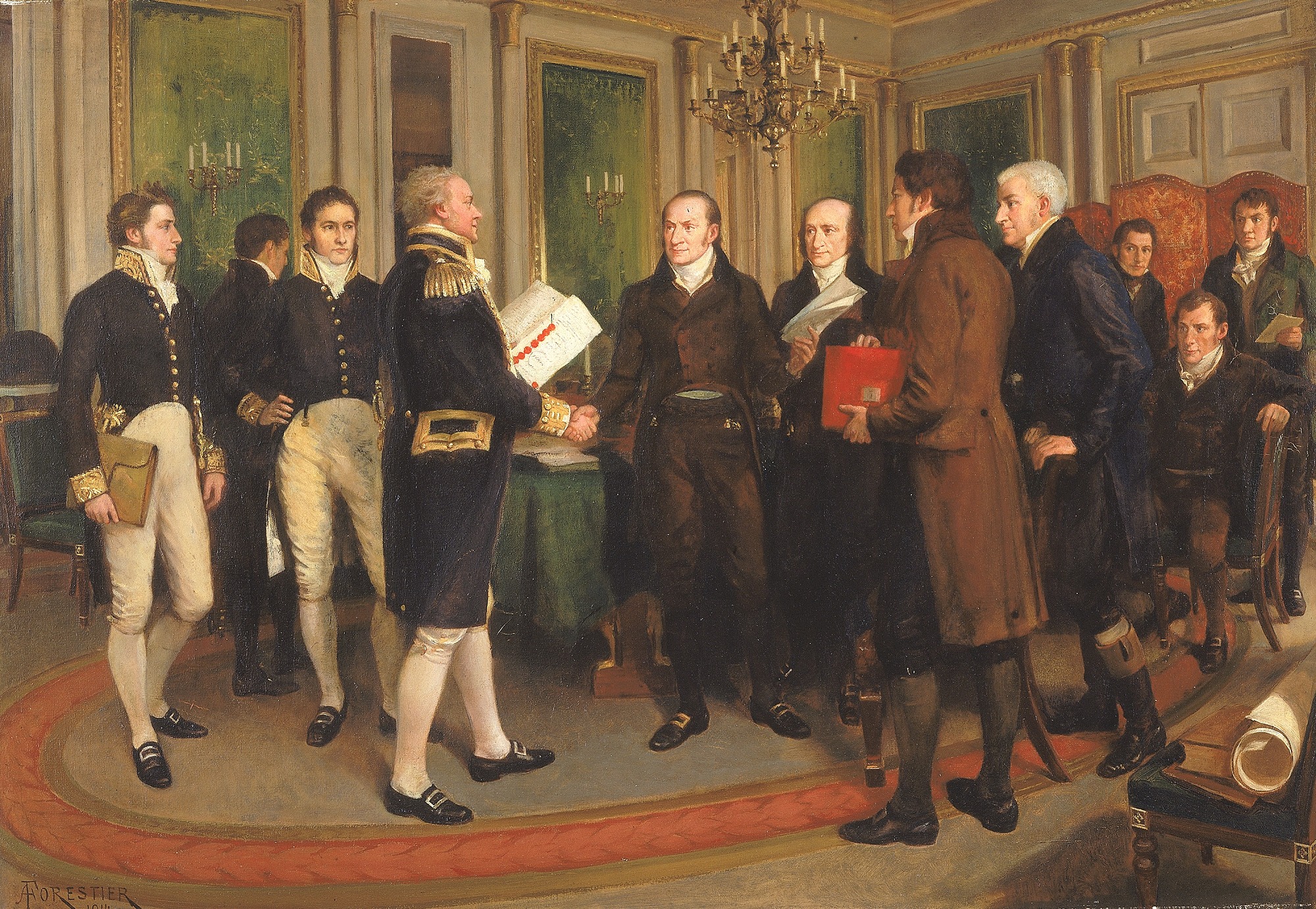
A few decades later, Adams occupied the most powerful positions in the diplomatic corps as the lead negotiator to end the War of 1812, the Ambassador to Great Britain, and the secretary of state. As Adams acquired experience, wisdom, and power, the young nation paralleled his rise. By 1820, the United States had steadily expanded west and south, displacing Native nations, and filling the land with white settlers and black enslaved workers. The American population had exploded, from 2 million in 1767 when John Quincy Adams was born to 9.6 million in 1820, and its economic power reflecting the growing demand.
The United States was still far from the global superpower that it would become, but Adams could envision the possibilities. As secretary of state, he crafted a foreign policy that would make that future possible. His vision centered on three policies: expanding the nation’s territory when it did not threaten the nation’s unity; participating vigorously in the global community while remaining wary of imperial ambitions in Europe; and defending the Union against threats foreign and domestic, especially slavery.
To pursue that vision, Adams engineered the purchase of the Floridas from Spain and staked the first claim to the Oregon territory. But Adams did not support unchecked imperialism within the confines of North America or the western hemisphere. He resisted expansion for the purposes of strengthening slavery, believing that the spread of enforced bondage would only undermine the bonds of Union.
Adams also used his platform to deter his fellow Americans and their European counterparts from meddling in the affairs of other nations. In an address on July 4, 1821—45 years into the life of the fledgling United States—Secretary of State John Quincy Adams famously declared that America, “goes not abroad, in search of monsters to destroy.” He explained that the country was “the well-wisher to the freedom and independence of all,” but that it had to be “the champion and vindicator only of her own.” Should the nation engage in “wars of interest and avarice,” he cautioned, then “She would be no longer the ruler of her own spirit.” Adams understood that enforcing American principles abroad would corrode the character of the nation.
“Should the nation engage in 'wars of interest and avarice'...she would be no longer the ruler of her own spirit.”
- John Quincy Adams
Two years later, he issued a similar warning to European nations. Adams wrote an official dispatch to Russia, a letter to Great Britain, and President Monroe’s annual address to Congress, all of which combined to form a policy declaration that “the American continents” had declared independence and henceforth are closed to “future colonization by any European powers.” This policy became known as the Monroe Doctrine, but it was Adams’s creation, and it defined American foreign policy for the nineteenth century.
As president, John Quincy Adams built on this vision of a strong, prosperous, virtuous America. He proposed infrastructure and education legislation to boost American industry and knit the fracturing Union together. He planted a nursery of saplings at the White House representing key moments from the nation’s history—including an acorn from the Tree of Liberty around which the Sons of Liberty gathered in Boston—and seeds from the oak tree in Baltimore that bore the scars of cannon fire from the War of 1812. He hoped that this reminder of their shared history would bind together his fellow citizens.
Adams also believed in a future where independent republics allied together against their enemies. In a presidential address to Congress, he argued that “any attempt” by European empires to extend their imperial reach “to any portion of this hemisphere” should be viewed as a threat “to our peace and safety.” Adams understood that dangerous forces across the Atlantic rarely stayed there.
Despite the wisdom in Adams’s proposals, partisan animosities, fracturing political coalitions, and the rise of new demographics defeated his vision. Martin Van Buren and Andrew Jackson, leaders of the emerging Democratic Party, coordinated to stymie the Adams administration in Congress. They also tapped into the enthusiasm of the swelling ranks of white male voters, who had recently gained suffrage with the abolition of property requirements. Many of these voters resented the New England intellectual elite embodied by John Quincy Adams and clamored for a less restrained type of politics, which the patrician Adams was uniquely unsuited to provide.
Adams’s proposals were shot down in Congress and he lost the election of 1828, but he had the final word. President Andrew Jackson’s allies in Congress passed infrastructure legislation that they had rejected just a few years earlier, including funds for a national road that connected Ohio to existing roadways. The proposals had not changed, just the president proposing them.

Rather than slinking into a quiet retirement, Adams did what no American president before or since has done: he returned to Congress. From the floor of the House of Representatives, Adams vehemently defended the Union for the next seventeen years against the threat posed by slavery. He successfully defeated the so-called “gag rule,” which sought to prevent northerners from discussing slavery on the floor of Congress, and won an argument in front of the Supreme Court in United States v. Amistad, securing the freedom of 35 Africans captured from Sierra Leone and forced into slavery. He also presciently warned that slavery would only be destroyed through blood and violence.
While his prophecies about civil war proved accurate, so too did his hope for the nation’s potential. President Theodore Roosevelt embraced the connection between natural preservation and the nation’s history, designating 230 million acres for conservation. President Woodrow Wilson outlined his Fourteen Points for international relations centering around the concept of self-determination, which Adams had championed in his July 4 speech. Finally, President Franklin D. Roosevelt understood the United States was more powerful alongside like-minded allies, just as Adams had argued in his presidential address.
As the global community enters a new era in the twenty-first century—characterized by shifting alliances, evolving power dynamics, and unpredictability—many Americans are rethinking their place in the world. John Quincy Adams’s vision served the nation in its founding and remains a guiding light as the nation celebrates its 250th birthday. This wisdom, and its lasting legacy, is a reminder that presidential leadership is timeless.
“Presidential leadership is timeless.”



Check out the lesson on Substack to be part of the discussion. Share your views, respond to others, and help deepen our understanding.
View on Substack