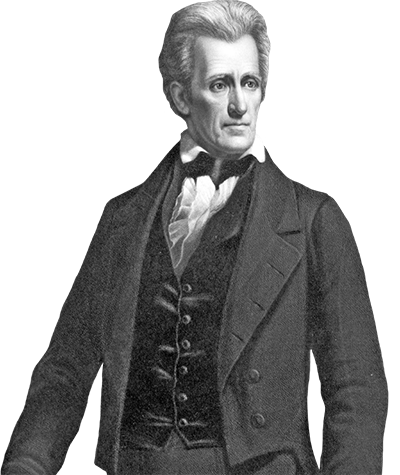
Throughout the summer months of 1844, newspapers across the country printed the bolded question: “Who is James K. Polk?” Earlier that May, the Democratic Party unexpectedly nominated the former speaker of the House of Representatives as its presidential candidate. Polk’s opponents mocked him as someone who could not even win a governor’s race in his home state of Tennessee, let alone the presidency. They accused him of changing his views for political expediency, and one columnist in the Knoxville Weekly Whig even called him a “slave of Andrew Jackson.” The two men were indeed political allies and friends, and Polk’s allegiance to Jackson had earned him the nickname, “Young Hickory.”
Like many quips in American politics, Polk’s supporters quickly embraced the phrase “Who is James K. Polk?” and used it to defend his positions and ridicule Kentucky Senator Henry Clay, the Whig Party presidential candidate who ironically also struggled to win elections. After Polk was narrowly elected that fall, his supporters continued to use the phrase to taunt detractors, answering gleefully with the line: “he is the President of the United States.” Today, the question is no longer posed as political satire but rather one of genuine curiosity: Who was James K. Polk? And what’s one important lesson that Americans today and beyond can apply from his life and leadership?
James Knox Polk was born in a log cabin in North Carolina in 1795. The Polk family soon thereafter moved to Tennessee, where James would eventually begin a career in politics. He attended the University of North Carolina and returned to practice law in Columbia, Tennessee. In 1824, he married Sarah Childress, a well-educated woman from a prominent family. Their partnership became the foundation for Polk’s rise to the national stage. Many nineteenth-century spouses were confidantes and gracious hostesses, but Sarah Polk was also a behind-the-scenes political operative—assisting with speeches, advising on issues, and even controlling access to her husband. Within their household, the Polks relied on enslaved people to provide many of the comforts and necessities they required; they also owned several plantation properties in Tennessee and Mississippi, further demonstrating that slavery sustained both their lifestyle and livelihood.
Polk was elected to the state legislature and later Congress, where he served seven terms in the House of Representatives, two of them as House speaker. Polk returned to Tennessee and was elected governor – however, he lost two subsequent elections, leaving many to believe that Polk’s political ascent was over. When the Democratic Party convened in May 1844, few would have surmised that “Young Hickory” would capture the nomination, but the party divided into factions over Texas annexation. Former president Martin Van Buren, who rejected annexation while in office to avoid war with Mexico and ease tensions between abolitionists and pro-slavery forces, was unable to secure the nomination. This left the door open for Andrew Jackson’s protégé and America’s first dark horse presidential candidate.
“America's first dark horse presidential candidate”
At age 49, Polk was the youngest person at that time to take the Oath of Office. Yet during the campaign, Polk pledged to serve only one term if the American people elevated him to the highest office in the land. Most politicians would not dare to make such a promise—then or now—or, at the very least offer some vague wording to placate supporters, keep political opponents on the defensive, and maintain some leverage with Congress. But President Polk did no such thing, and stepped aside after four years in the White House.
Polk outlined five major priorities for his single term: to annex Texas and secure its statehood; negotiate the disputed Oregon Territory with Great Britain; acquire more western lands, specifically New Mexico and California; establish an independent treasury; and reduce the tariff. Polk achieved each of these ambitious goals and, fueled by sentiments of “Manifest Destiny,” acquired more than one million square miles of territory through war and diplomacy. Yet his successes sowed the seeds for calamity. They justified provoking a war with Mexico, displacing Indigenous peoples from their ancestral lands, and expanding the reach of slavery far into the American West—all of which made the United States a politically unstable continental power. Polk reminds us that in power may be limited, but the consequences of their decisions are not.
Expansionism was not a new phenomenon; in fact, it arguably predated American independence. The first president, George Washington, envisioned that a strong chief executive would determine foreign policy, mediate relations with other nations, and involve the Senate only as required by the Constitution. While his successors’ views of executive power varied, they all used presidential authority to engage in diplomacy, negotiate, and if need be, use military force to acquire territory from France, Great Britain, Spain, and Indigenous peoples.
The larger complicating factor was slavery, and where to draw the line, both literally and figuratively. This herculean task fell to Congress, which incessantly debated whether slavery should be allowed in new territories. With increasing polarization and anti-slavery sentiment on the rise, Congress’ solution was to balance the number of free and slave states admitted into the Union. Territorial gains often foreshadowed political crises, and while Congress defused these situations with fragile agreements like the Missouri Compromise of 1820, every subsequent escalation made this balancing act that much harder to sustain.
The longstanding border disputes between the United States, Mexico, and Texas offered President Polk the opportunity to pursue one of his major policy objectives. When diplomacy failed, he directed General Zachary Taylor to march U.S. troops into contested territory between the Nueces and Rio Grande Rivers. The Mexican government, which did not recognize Texas independence nor its proclaimed boundary of the Rio Grande River, viewed the American soldiers as an invading force and attacked them. In his message to Congress, the president stated: “Mexico has passed the boundary of the United States, has invaded our territory and shed American blood upon the American soil.”

Polk’s framing of the conflict as one of national pride and self-defense persuaded members of Congress to vote overwhelmingly for war, though it was not without controversy. A then-relatively unknown Whig representative from Illinois named Abraham Lincoln accused the president of inciting bloodshed, introducing several resolutions asking the administration to identify the exact spot where the conflict began on American soil. Representative David Wilmot of Pennsylvania attempted to add an amendment to the war appropriations bill prohibiting slavery in any future territory acquired from Mexico. While it never passed the Senate, Wilmot’s Proviso marked an important turning point as anti-slavery forces began to coalesce and politically organize, later forming the Free Soil Party and eventually the Republican Party that Lincoln led as president.
The Treaty of Guadalupe Hidalgo resulted in the United States receiving more than 525,000 square miles of territory from Mexico—today known as New Mexico, California, Utah, Nevada, and portions of Arizona, Colorado, Wyoming, Kansas, and Oklahoma. It was the largest territorial expansion since the Louisiana Purchase in 1803, and arguably Polk’s greatest accomplishment as president. However, his aggressive pursuit of expansionism fractured the two-party system over the issue of slavery. These territorial gains widened sectional divides over slavery’s expansion, heightened political turmoil, and put the country on the path to civil war.
Polk’s achievements ultimately came at a great cost, though he did not live to see it. After leaving the White House, the Polks embarked on a tour of the states and the former president was celebrated and cheered by crowds along the way. Near the end of the trip, Polk likely contracted cholera and died a little more than 100 days after leaving office—the shortest post-presidential tenure of any U.S. president. But the repercussions of his decisions would be anything but short.
“His successes sowed the seeds for calamity.”

Check out the lesson on Substack to be part of the discussion. Share your views, respond to others, and help deepen our understanding.
View on Substack