When Sarah Childress Polk became first lady of the United States in 1845, women couldn’t vote, serve as ministers, write legislation, or speak freely at political meetings. If married, they couldn’t own property and were considered their husbands’ property. Marital rape was not recognized, and fathers gained custody of children in divorce.
During the Polks’ four years in the White House, women in upstate New York began demanding equal rights, including property and voting. Sarah Polk, celebrated as pious and deferential, opposed the women’s rights movement. Yet she wielded enormous political power in Washington. Her career demonstrates that political power doesn’t always come from voting or holding office, but from wealth, connections, and influence hidden from public view.
Sarah Childress was born in 1803 on the Tennessee frontier. Without her 1824 marriage to James K. Polk, her name would likely have been forgotten, like that of most nineteenth-century women. Rumor had it Andrew Jackson encouraged Polk to court Sarah. He hardly needed urging: she was charming, well-connected, wealthy, and unusually well educated. Her prosperous father recognized her intelligence and sent her to Salem Academy, the premier women’s school in the South. James admired her sharp mind and outgoing personality.
Sarah was in many ways a conventional Southern woman: a strict Presbyterian, she accepted hierarchy as divinely ordained—white above Black, men above women. Yet she was also unusual. She was the only first lady who neither bore nor adopted a child (she and James were happy as a unit of two) and she delighted in politics, not only policies but the gossip, coalition-building, and elections that drove party life. She inherited this interest from her father and brother, who both took her views seriously, and shared it with James, who eagerly drew her deeper into his political world. Her wealth, education, and political connections gave her the confidence to grasp the power he offered her, even as she asserted that women belonged to a separate sphere from men, and that politics were firmly within the male sphere.
James joked that Sarah only agreed to marry him because he promised to run for Congress. He did and unlike most wives, Sarah accompanied him to Washington. Sarah thrived in Washington’s rough boardinghouse environment. She transformed their living space into a political salon, renting rooms specifically for entertaining James’s colleagues. She became friends with many of those men, who confided in her things they might not tell another man.
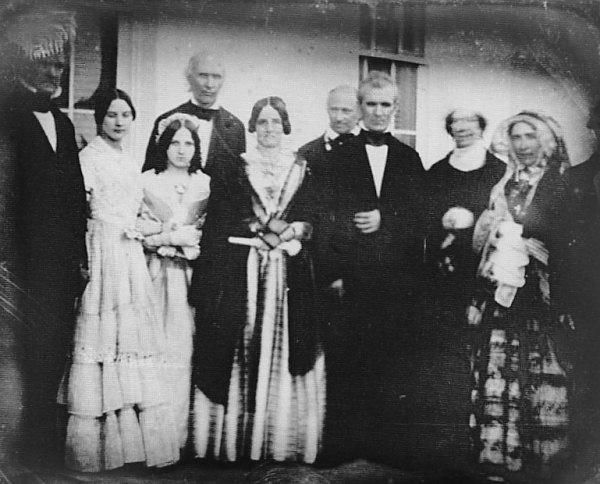
Sarah’s political acumen was recognized in Washington political circles. James rarely ignored her advice, and senators, congressmen, and even a Supreme Court justice wrote to her for information about her husband’s views and political campaigns. Late in her life she recalled that when she begged her workaholic husband to put away his papers at night, he gave her a stack to read for him instead.
James also encouraged Sarah to join him when he traveled for work. “Why should you stay at home?” he asked. “If the house burns down, we can live without it.” Their partnership was unusually egalitarian for its time, built on mutual dependence and shared ambition.
Sarah remained in Washington for thirteen years, through James’s rise to Speaker of the House. When they left in 1839 so he could run for governor of Tennessee, politicians lamented her absence. A Supreme Court justice even praised her “playful mind” in verse. During his campaigns, she coordinated strategy, and on his orders gathered intelligence and lobbied on his behalf. Their correspondence reveals the depth of their bond: when she despaired of his long absences, he resolved they would never again be parted for more than a week.
James’s fortunes shifted dramatically in 1844 when the question of Texas annexation split the major parties. Polk embraced annexation, invoking Manifest Destiny, and Sarah shared his fervor. His stance catapulted him to the Democratic nomination. Sarah again coordinated his campaign, and at forty-two entered the White House as first lady. She set up an office beside his, poring over newspapers and marking items for him to read. They worked twelve to fourteen hours a day. “None but Sarah knew so intimately my private affairs,” James admitted. Though she downplayed her role, she was effectively his chief of staff.
“None but Sarah knew so intimately my private affairs.”
- James K. Polk
In public, Sarah cultivated an image of propriety and restraint. She banned liquor, dancing, and cards from the White House, yet her dinners and receptions were admired for their elegance and effectiveness. Dressed in sober but finely tailored gowns, she entertained tirelessly—two evening receptions weekly, plus Saturday mornings during congressional sessions. When James was absent, she hosted alone, impressing powerful men who often preferred her company to his. She met politicians privately as well, lobbying them directly on behalf of Polk policies.
Her control of access to her husband proved crucial during the U.S.-Mexican War. Polk’s diaries suggest he was often shielded from discontent, thanks to Sarah’s management of his information flow. She ensured he saw supportive editorials, shielded him from harsh criticism, and lobbied congressmen and editors for support. The press noticed her activism but cast it as feminine devotion rather than political power. Sarah reinforced this image, attributing her views to “Mr. Polk” and avoiding overt displays of opinion. She had what a contemporary called “intuitive tact.” She was “too delicate and reserved to proclaim political opinions, or to join in the discussion of party differences. Being so intelligent and well informed, yet so unobtrusive, she was a charming companion.”
The public adored but misunderstood her. She knew how to control her image, staging media events that highlighted her public charity, decency, and thrift. Newspapers praised her seeming commitment to pious subservience and democratic equality as “a model for every woman to imitate.”
Yet behind the scenes she was politically shrewd, even managing secret slave transactions for the family plantation, giving James plausible deniability he needed to maintain his image. Her wealth and upbringing provided her with a sense of entitlement that was vastly different than her public image.
The Presidency was harder on James than Sarah. She thrived in office, but by his third year his health was visibly failing. He died three months after leaving office. Sarah survived another forty-two years. In her later life she was venerated by both the Daughters of the Confederacy and the Women’s Christian Temperance Union for her piety and devotion to her husband, her true political power forgotten.
Sarah Polk became the most politically powerful first lady of her time by obscuring her influence. By claiming deference to her husband and cultivating an image of piety she appeared conservative next to the radicals of Seneca Falls, who insisted that women were equal to men. She excelled at politics without threatening men, embracing an image of female subservience. Her story shows that while democracy promises political power through election, real power often derives from wealth, connections, and influence hidden from public view.
“Sarah Polk became the most politically powerful first lady of her time by obscuring her influence.”
Check out the lesson on Substack to be part of the discussion. Share your views, respond to others, and help deepen our understanding.
View on Substack