Lesson #
13
• FROM
William Henry Harrison
March 4, 1841, came to Washington under a lid of cloud and a hard, restless wind. The cold carried up the streets and climbed the Capitol steps. Wool felt thinner than it should.
Tens of thousands of Americans lined the streets that day — banners flapped in the breeze as a procession of bands and replica log cabins (a symbol of the Harrison campaign) made their way down the route.
William Henry Harrison — “Old Tip” — rode from his hotel to the Capitol on a white horse, wearing no overcoat and no gloves, despite the relentless cold.
At 68, he was the oldest president the country had sworn in so far. Chief Justice Roger B. Taney administered the oath that transforms an ordinary citizen into a president.
The next part of the inauguration ritual usually offered a tidy shape: an inspirational short address, a set of presidential priorities, and a closing line people could tuck into their pockets to carry home.
Harrison chose something else.
When he began to address the nation for the first time, the speech kept unfolding –– dense, sweeping, packed with history and warning. It took nearly two hours to deliver the 8,445 words.
A month later, Harrison was dead.
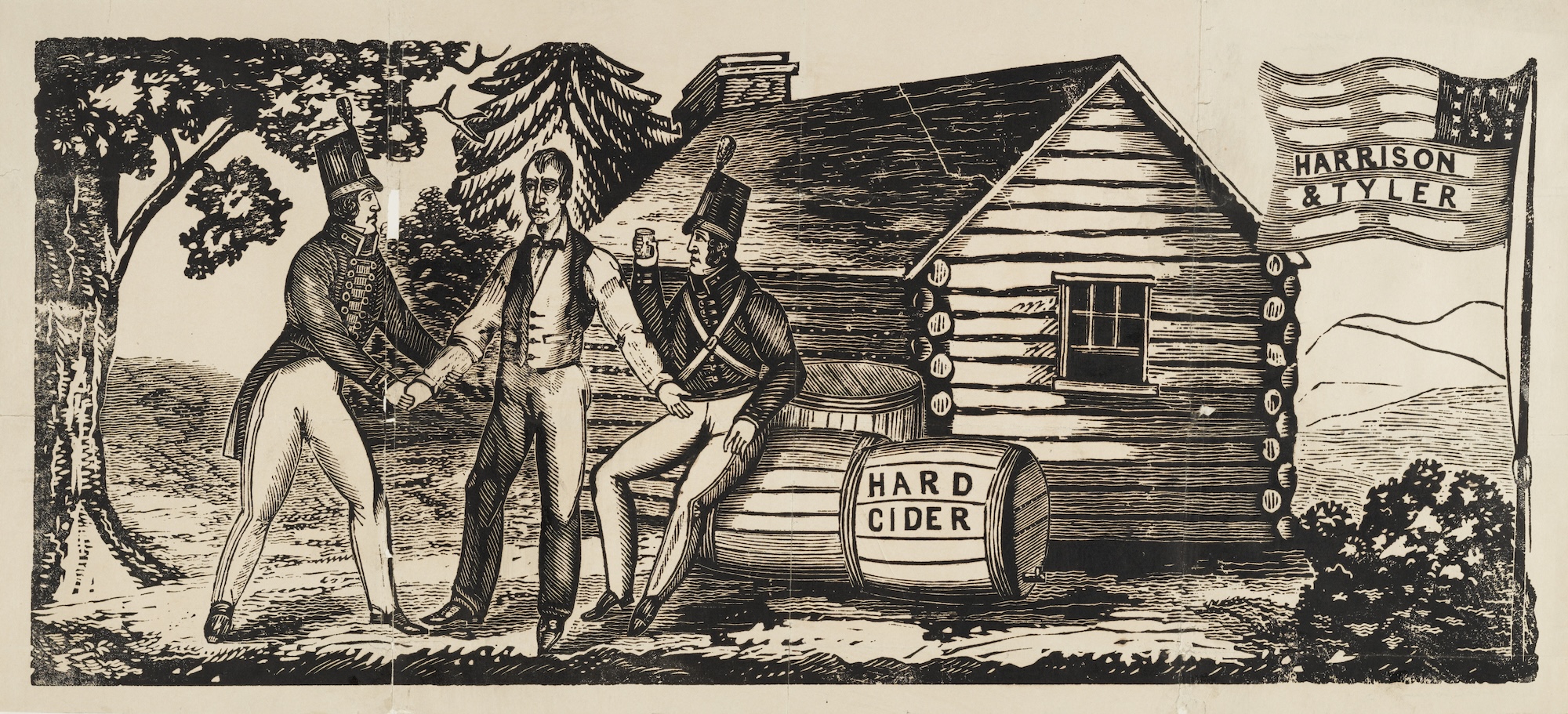
Four years earlier, Americans had watched the economy seize up. The Panic of 1837 triggered bank failures, collapsing credit, business closures, and deep insecurity. Martin Van Buren had inherited much of that crisis, and the Whig Party — of which Harrison was a part — treated the economic pain as a moral indictment of Van Buren, mocking him as “Van Ruin.” They offered Harrison as a kind of national reset — an old soldier with a simple image — maple syrup and a catchy slogan — and a promised return to balance.
The campaign itself carried a hint of the political future: mass rallies, merch, songs, spectacle. The country learned that elections could be won through story as much as through argument.
Harrison, perched above the crowds at his inauguration, didn’t offer an auspicious vision of the future. Instead, he issued a series of constitutional warnings. Undergirding them all was a broader lesson that would continue to reverberate throughout the nation’s history: a republic, he cautioned, endures only when the people are loyal to the principles of democracy rather than the interests of political parties.
“The country learned that elections could be won through story as much as through argument.”
“The great danger,” Harrison told the country, “does not appear to me to be in a usurpation… of power not granted,” but in “the accumulation in one of the departments of that which was assigned to others.” He meant the executive branch in particular, and described a system of democracy that stays free only when each branch’s power is limited — when Congress acts like Congress, courts act like courts, presidents act like presidents, and none of them swallow the rest.
That is a lesson that does not expire. A republic survives by distributing power so broadly that no single person can hold it all.
Harrison paired that warning with a second, equally durable claim: democracy carries limits.
He praised the foundations of the American constitutional republic as a government resting on the people, but he refused to treat “the people” as an unlimited force. Sovereignty, he argued, does not mean the majority can do whatever it wants. Americans possess “power precisely equal to that which has been granted” in the constitutional compact, and individual citizens retain rights they never surrendered — some they could not surrender because they are unalienable. He anchored liberty in something sturdier than public mood.
Read in plain language, his claim is simple: rights do not become real because they are approved by the public, they remain protected regardless of which way the political winds might blow.
Harrison’s third lesson comes with a sharper edge: he wanted his listeners to recognize a particular kind of political fraud.
He described what he called “the old trick of those who would usurp the government of their country.” The trick wears a familiar costume: leaders speak “in the name of democracy,” stirring fear about aristocracy and wealth, framing themselves as the people’s only defender.
He gave his listeners a way to tell the counterfeit from the real thing. He described liberty as “mild and tolerant and scrupulous as to the means it employs,” while the spirit that impersonates liberty is “harsh, vindictive… intolerant, and totally reckless.” A movement that claims it protects freedom while discarding restraint announces its destination long before it arrives.
The fourth warning runs straight into the modern bloodstream.
Harrison turned, near the end, to political parties. He accepted that parties can produce vigilance to keep the government in check. Then he drew a boundary: past that point, parties corrode liberty, the very thing they claim to defend. According to Harrison, parties “become destructive of public virtue… and eventually its inevitable conqueror.”
Harrison’s words were carried into the cold wind at the exact moment he acquired the most power a citizen could hold.
Then history delivered its own ending. Harrison would become ill –– historically attributed to being outside without a coat, but perhaps a combination of pneumonia and sepsis from Washington’s contaminated drinking water. A month after taking office, he died.
His death forced the country to face the kind of institutional stress he had been describing: a sudden vacancy, a republic asked to keep functioning despite the loss of its leader, a Constitution asked to do its work while citizens watched. Vice President John Tyler stepped into the role. The nation learned, in real time, that continuity mattered as much as charisma.
Harrison’s inaugural address endures for a reason that has little to do with policy or even length. It outlined a set of civic instincts that keep a country free.
Power belongs in more than one set of hands. Rights sit above majority impulse. Beware anyone who uses the language of democracy as a mask for domination. Parties can replace the common good with permanent factions.
Those lessons do not require agreement about the issues of the day, they require agreement about the kind of country we intend to remain.
Harrison stood on the Capitol steps that blustery March afternoon and warned Americans that the republic’s greatest threats often arrive dressed as familiar things: urgency, righteousness, loyalty, victory. His presidency vanished almost as soon as it began. His warnings stayed.
“The great danger does not appear to me to be in a usurpation… but in the accumulation in one of the departments of that which was assigned to others.”

Check out the lesson on Substack to be part of the discussion. Share your views, respond to others, and help deepen our understanding.
View on Substack