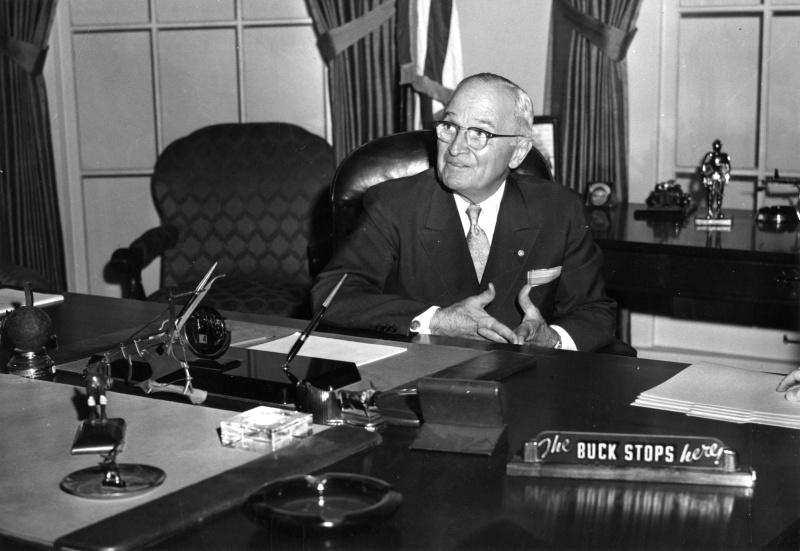
In late April 1945, the war in Germany and Japan was still raging. Franklin D. Roosevelt, the man who had been President for 12 years, was gone. In his place was an untried, unsophisticated, former senator from Missouri who had been Vice President a mere 82 days. But, despite his inexperience, Harry S. Truman would prove to be one of the finest leaders in U.S. history, his decisions shaping the world for decades to come. The essence of Truman’s leadership was captured on a wooden sign displayed on the Resolute Desk—crafted in an Oklahoma federal reformatory of all places, and gifted to Truman by a U.S. marshal friend. It famously read: “The Buck Stops Here.”
Truman grew up on a farm near Independence, Missouri. Dirt poor with no formal education, there was nothing about the young Truman that foreshadowed greatness. He grew up Baptist but not ostentatiously so. Before entering public life, he spent his early years bouncing around various jobs: working on the railroad, clerking at a bank, helping with the family farm and trying his hand at several unsuccessful businesses. However, Truman embodied the qualities of the Midwest farmer. He was hard working, honest, and outgoing—with a sense of humor that endeared him to the people he met.
Leadership seemed to come naturally to Truman. During WWI he enlisted in the Army and rose to the rank of Captain while commanding an artillery battery. The soldiers that served with Truman remembered him as fair, disciplined, and courageous under fire. It was in the service that he learned to lead men and make the hard decisions necessary for success on the battlefield. Truman would later note that his time in Army was a turning point in his life.
After the war, Truman entered public life. Although he was backed by Kansas City’s Democratic “Pendergast Machine,” a notorious and influential political operation, Truman managed to keep his reputation for fairness and integrity by avoiding the machine’s shady deals and the wanton corruption. Truman once said that Pendergast “was my political sponsor, but he never owned me.” This steadfastness, along with Truman’s belief in Midwest values and determination to do what was right, were early indicators of the leader he would become.
In 1944, FDR selected Truman to be his running mate, but their relationship was never strong. FDR didn’t want Truman as his Vice President. He didn’t care for Truman as a person, and had no desire to build a friendship. Worse, FDR didn’t confide in Truman on the several critical issues, including the Manhattan Project. When Truman was thrust into the role of President, he exclaimed, “I felt like the moon, the stars and all the planets had fallen on me.”
“I felt like the moon, the stars and all the planets had fallen on me.”
- Harry Truman
What was to fall on Truman was the decision to use the most lethal weapon ever devised—the atomic bomb. Just 24 hours after being sworn in as President, the Secretary of War, Henry Stimson, and the head of the Manhattan Project, General Leslie Groves, briefed Truman on this fearsome new weapon. That same month the U.S. invaded Okinawa at a cost of over 12,000 U.S. Marines killed and 49,000 wounded, in addition to over 100,000 Japanese soldiers killed. Despite their staggering losses and the inevitability of the war’s outcome, the Japanese refused to surrender. It appeared that an invasion of the Japanese mainland was the only alternative. Truman’s military advisors informed him that a U.S. invasion would cost between 250,000 and one million American lives, with the Japanese casualties being even higher.
Now armed with the knowledge of the atomic bomb, Truman confronted one of the most difficult decisions in America history. Yet perhaps no man was better suited to make that decision. Truman, the man of faith, weighed the moral implications. Truman, the soldier, weighed the strategic implications. Truman, the President, weighed the political implications. In the end, Truman, a man who believed in Providence, who believed in divine responsibility, who believed leaders were responsible to higher power, made the decision that the atomic bomb was the surest and fastest path to ending the war—sacrificing hundreds of thousands to save millions.
Truman’s decision will continue to be hotly debated. Would an invasion indeed have cost millions of lives? Could the United States have convinced the Japanese to surrender without fighting? Was it morally acceptable to kill hundreds of thousands of innocent people to stop the war? Less debatable is the unfathomable weight of that decision and Truman’s refusal to shirk the demands of leadership at a crucial moment.
Truman would be tested again and again during his time in office. Just five years after the end of WWII, another war broke out—this time on the Korean Peninsula. In June 1950, North Korea invaded South Korea, pushing the South Korean Army and a small contingent of American soldiers all the way back to the city of Pusan, deep in South Korea. Surrounded by the North Koreans, the remaining South Korean and American soldiers consolidated in the “Pusan Perimeter.” It was about to be an American Dunkirk.
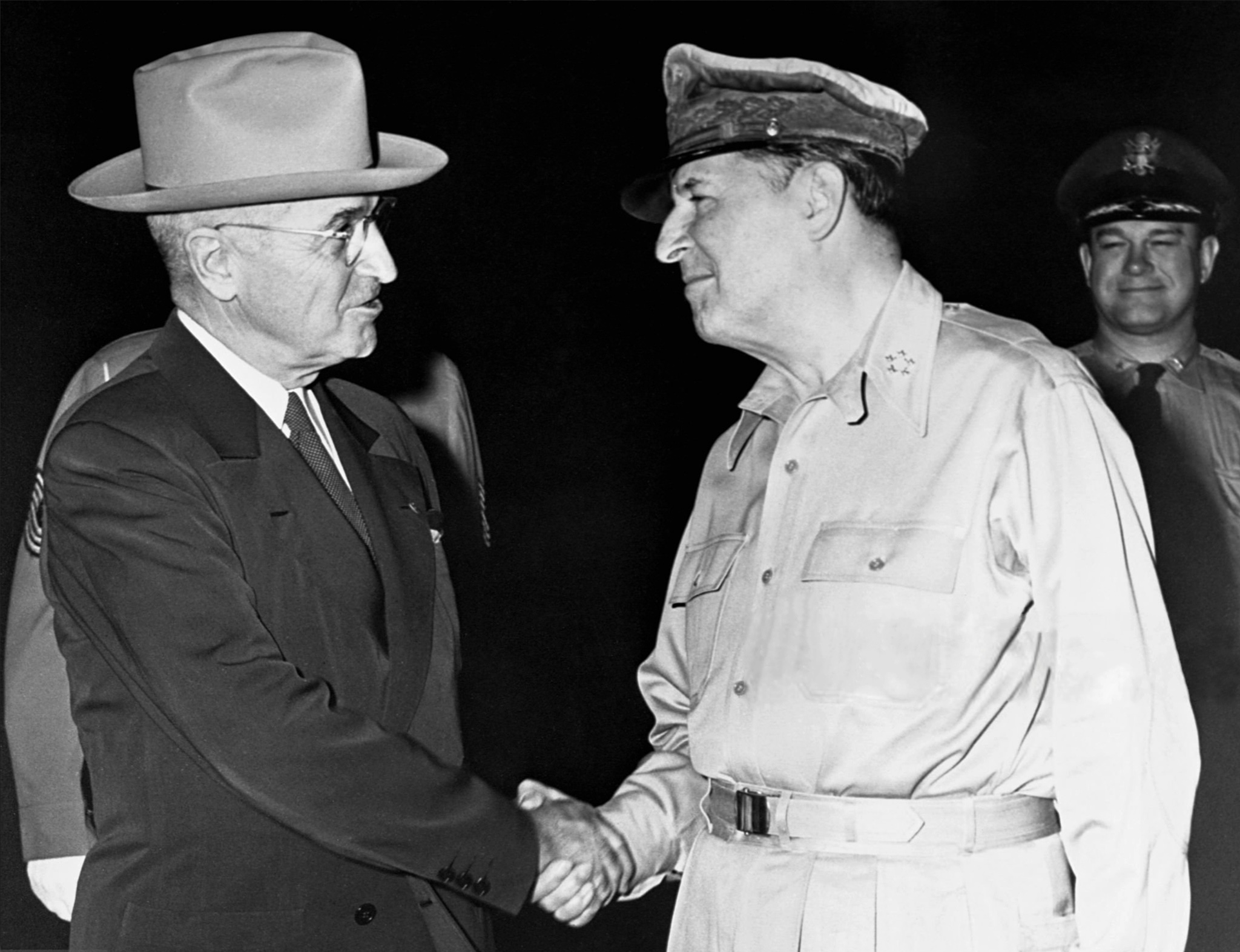
Without hesitation, Truman committed air, naval, and ground forces to fight back. To lead this effort, Truman turned to an American hero, General Douglas MacArthur. MacArthur, a brilliant general with a reputation for bold, decisive action, was also a man with a soaring ego and little time for politicians in Washington. MacArthur mustered his forces and conducted a major amphibious landing in Inchon, forcing the North Koreans to retreat and saving the South Korean and American soldiers trapped in Inchon. The maneuver is still considered one of the most audacious and well-conceived operations in military history.
Emboldened, MacArthur pushed the enemy back past the famed 38th Parallel all the way to the Yalu River on the border with China. Truman had made clear to MacArthur that his orders were to contain the conflict to the Korean Peninsula and not encourage the Chinese to intervene. Truman felt strongly that if China or Russia entered the conflict it could lead to WWIII. MacArthur had different ideas. He blatantly ignored Truman’s orders and pushed his forces far into North Korea. In October 1950, the Chinese entered the war, surrounding the 1st Marine Division at the Chosin Reservoir and forcing the Marines to execute a heroic but embarrassing retreat.
After several more incidents of insubordination, Truman was forced to make another difficult decision. MacArthur—the hero of WWII, the hero of the Inchon Landing, a towering figure in American culture—needed to be fired. Like any good Midwesterner, Truman attempted to resolve the situation man to man. In a show of goodwill, he travelled nearly 14,500 miles to Wake Island to meet with MacArthur and hopefully resolve the issue. During the meeting, MacArthur repeatedly misled or lied to Truman. The final straw came when MacArthur openly rebuked the Commander-in-Chief. Truman dismissed the general.
It is difficult to appreciate today how stunning Truman’s act was. One senator noted that his constituents were “almost hysterical” and others floated impeaching Truman. MacArthur went on to deliver a defiant address to a rapt Congress, followed by a ticker-tape parade through New York City that drew an estimated 7.5 million cheering Americans. Observers speculated that MacArthur was a shoe-in to be president—or perhaps he’d lead his adoring hordes to march on the White House itself. Yet Truman stood firm, convinced that “the American people will come to understand that what I did had to be done.” By making an example of MacArthur’s insubordination, the Man from Independence reinforced the sacred principle of civilian control of the military and set a standard for every president to come.
Under Truman, the buck did not pass. Neither should his example.
“Under Truman, the buck did not pass. Neither should his example.”
Check out the lesson on Substack to be part of the discussion. Share your views, respond to others, and help deepen our understanding.
View on Substack