Lesson #
22
• FROM
Abraham Lincoln
Most Americans know Abraham Lincoln as a marble giant, the Great Emancipator, the president who saved the union. But it is perhaps more instructive, and more honest, to see him as he was in the decade before he rose to the White House: a Springfield lawyer who’d served just a single term in Congress.

Possibly in his law office, his feet on a cluttered desk, his sons playing around him, his clothes a bit too small to fit his uncommon frame, he put some thoughts on paper — for what purpose we do not know. “The legitimate object of government,” he wrote, “is to do for the people what needs to be done, but which they can not, by individual effort, do at all, or do so well, by themselves.”
It’s impossible to know for sure, but I suspect Lincoln’s conviction did not come from a belief that government always had the answer, or a failure to understand our individual rights and responsibilities.
Born in a log cabin of pioneer stock, Lincoln cleared a path through the woods as a boy, lost his mother and a sister to the rigors of frontier life, and taught himself everything he knew. He understood, perhaps better than anyone, what it means to pull yourself up by your bootstraps, and how personal liberty and self-reliance are at the heart of the American experience.
But Lincoln also understood something else. He recognized that while each of us must do our part, work as hard as we can, and be as responsible as we can — in the end, there are certain things we cannot do on our own. There are certain things we can only do together. There are certain things only a union can do.
Only a union could harness the courage of our pioneers to settle the American west, which is why he passed a Homestead Act giving a tract of land to anyone seeking a stake in our growing economy — though at great cost to Native peoples.
Only a union could foster the ingenuity of our farmers, which is why he set up land-grant colleges that taught them how to make the most of their land while giving their children an education that let them dream the American dream.
Only a union could speed our expansion and connect our coasts with a transcontinental railroad, and so, even in the midst of civil war, he built one.
Only a union could spur innovation and ignite America’s imagination on a national scale, which is why he established a national academy of sciences, believing we must, as he put it, add "the fuel of interest to the fire of genius in the discovery…of new and useful things."
And only a union could serve the hopes of every citizen — to knock down the barriers to opportunity and give each and every person the chance to pursue the American dream.
In hindsight, this notion may seem uncontroversial. Yet Lincoln knew, better than anyone, that our union was not, and is not, inevitable. He’d witnessed how, at crucial moments, our improbable experiment in self-government nearly flickered out — and he was determined to keep the flame of liberty alive.
When the outbreak of war halted construction of the new Capitol dome, Lincoln ordered that work resume. Critics accused him of diverting resources and manpower from the war effort. But Lincoln recognized that the dome was more than a construction project. “If the people see the Capitol going on,” he replied, “it is a sign that the union shall go on.”
Lincoln’s efforts went well beyond the symbolic. Throughout the fiery trial of civil war, he felt compelled to make compromises — some of them distasteful — to preserve the fragile union. Intent on keeping the border states from seceding, Lincoln rebuffed demands from some in his party for immediate nationwide emancipation and revoked a premature emancipation order issued by one of his generals in Missouri. When Lincoln ultimately issued his own Emancipation Proclamation, he conspicuously exempted the border states. “I hope to have God on my side,” he reportedly said, “but I must have Kentucky.”
“I hope to have God on my side, but I must have Kentucky.”
- Abraham Lincoln
Nor was Lincoln above infringing on civil liberties when he deemed it necessary, declaring martial law, suspending habeas corpus, and arresting suspected secessionists in states like Maryland and Missouri. This was the price, as he saw it, of holding together an unwieldy coalition that could defeat the Confederacy.
Over the course of the war, Lincoln’s understanding of the union deepened and expanded. What began as a constitutional battle to preserve the nation as a legal entity became, in his mind, a moral struggle over what kind of country America would be.
That evolution came into focus at Gettysburg. When Lincoln arrived there in November 1863, the rolling fields still bore the scars of one of the bloodiest battles ever fought on American soil. Workers had labored for ten days to clear the dead. Lincoln himself was exhausted and ill — “a ghastly color,” one of his cabinet secretaries observed. Edward Everett, one of the most celebrated orators in America, delivered a two-hour address. Then Lincoln rose and spoke for barely two minutes.
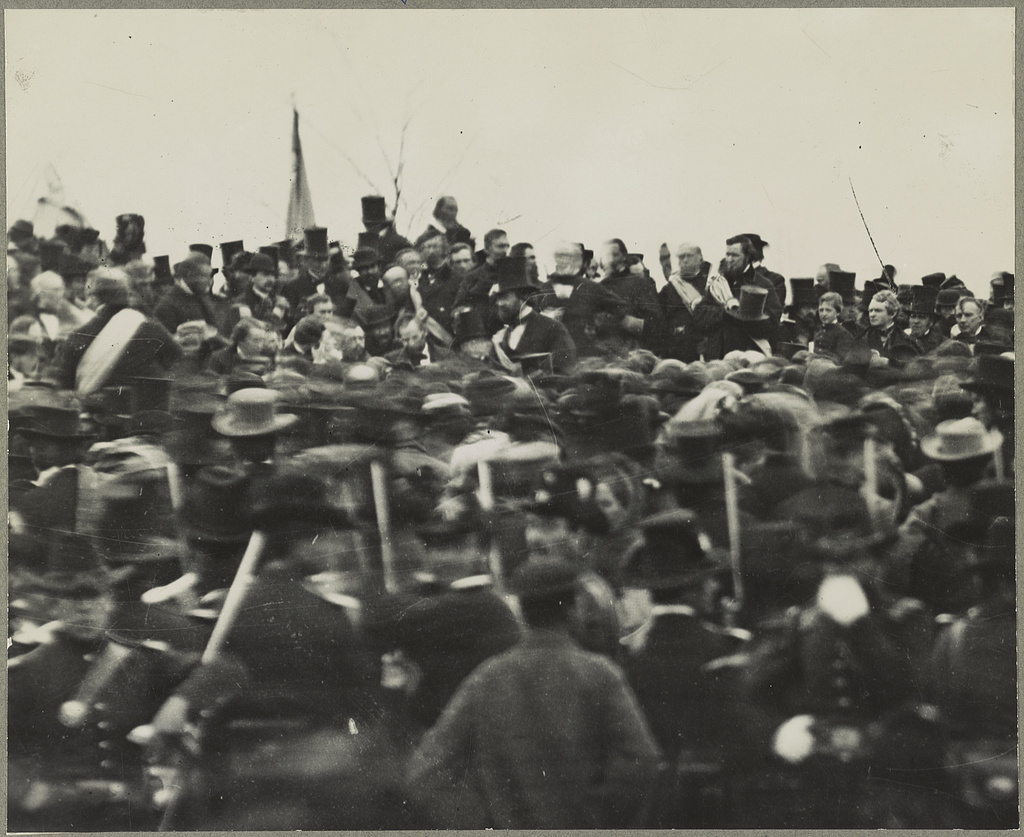
In just 272 short words, Lincoln transformed the meaning of the war and the union itself.
No longer were the states mere parties to a contract, as he described them in his First Inaugural. The United States was now a nation “conceived in liberty, and dedicated to the proposition that all men are created equal.” The sacrifices at Gettysburg had given the Union a moral purpose beyond itself, an “unfinished work” testing whether government of the people, by the people, for the people could survive at all.
Once Lincoln came to see the union this way, triumph on the battlefield was not enough. If the nation was to endure, it would have to emerge from war true to the ideals for which so many had fought and died. By the time Lincoln delivered his Second Inaugural Address near the war’s end, he would call on Americans to move forward without malice, realizing that a lasting union required not only victory, but restraint; not only strength, but a sense of shared obligation to one another.
Lincoln understood what George Washington understood when he led farmers, craftsmen, and shopkeepers to rise up against an empire. What Franklin D. Roosevelt understood when he lifted us out of the Great Depression, built an arsenal of democracy, and created the largest middle-class in history with the GI Bill. What Dwight D. Eisenhower understood when he created an interstate highway system that knit together cities and towns across the country. What John F. Kennedy understood when he sent us to the moon.
All these presidents recognized that America is — and always has been — more than a band of thirteen colonies, more than a bunch of Yankees and Confederates, more than a collection of red states and blue states. We are the United States of America and there isn’t any dream beyond our reach, any obstacle that can stand in our way, when we recognize that our individual liberty is served, not negated, by pursuit of the common good.
More than anything, that’s what Abraham Lincoln taught us. That union is not simply a matter of law or accident of geography, but a moral commitment we make to our fellow citizens and to our shared future. That democracies endure not only because of constitutions or armies, but because free people choose, again and again, to bind their fates together. That only by maintaining a sense of shared sacrifice and responsibility — for ourselves and one another — can we do the work that must be done in this country. And that it is precisely when the climb is steepest that we relearn how to take the mountaintop, as one nation and one people.
That’s the very definition of what it means to be American. And together, that’s how we will do what Lincoln called on us to do, and “nobly save…the last best hope of earth.”
“Democracies endure not only because of constitutions or armies, but because free people choose, again and again, to bind their fates together.”
- President Barack Obama

Check out the lesson on Substack to be part of the discussion. Share your views, respond to others, and help deepen our understanding.
View on Substack