Lesson #
7
• FROM
Dolley Payne Todd Madison
During her tenure as First Lady (1809-1817), Dolley Payne Todd Madison was one of the most well-known people in the new United States and certainly the most well-known woman. Her fame persisted through the nineteenth and twentieth centuries and continues into the present day. When we think of Dolley, the word “hostess” crops up repeatedly to explain her achievements, most notably her large, weekly receptions. It is all too easy to dismiss her just as the organizer of fabulous parties. If we place Dolley’s social work in the context of the larger political culture of the early United States, however, we see its importance: Dolley carefully constructed a social world that became an unofficial sphere where friends and enemies could resolve some of their differences and translate political ideas into concrete action.
During the American Revolution, male politicians determined that the nation’s new government would be based on a theory called “republicanism.” In contrast to Old World courts ruled by powerful kings, like “The Sun King” Louis XIV of France, the founders of the United States envisioned a weak government that depended on virtuous legislators who were united in pursuit of the common good. A side effect of republicanism’s assumption of a single common good was that any difference of opinion was seen as traitorous. In the years after independence, Americans discovered that their own inability to tolerate disagreement was proving disastrous for a nation that had barely begun. Cracks began to appear during George Washington’s presidency as Alexander Hamilton and Thomas Jefferson battled over the meaning of the nation’s common good. In this “all or nothing” atmosphere any kind of cooperation with “the enemy” was regarded as the deepest betrayal. No wonder congressmen quarreled among themselves, sometimes fighting to the death.
As early as 1800, it was clear that a government based on a theory that all the governing men could agree on a single common good was not working. Effective politics requires compromise and cooperation. In the glare of the official spotlight, congressmen could not be seen making alliances or reaching across the aisle. This is where the unofficial sphere comes into play. The social sphere – a drawing room, a parlor, an intimate gathering, or a large party – provided opportunities for connection that republican political theory made nearly impossible.
Unofficial spaces have a long history in kingly courts and even presidential ones, but the political culture of Washington City needed them even more urgently. Even before James Madison took office in 1809, Dolley set her sights on the Executive Mansion, the setting for her most influential creation—an unofficial sphere for a new political system. James’s predecessor, Thomas Jefferson, had deliberately discouraged large, inclusive events; in his time, the Executive Mansion was a lonely house on a hill. In contrast, Dolley and architect Benjamin Henry Latrobe designed lavish rooms intended for entertaining large groups. Before her restructuring, there was no one place in the capital city that could hold all the official men. Dolley made sure that her rooms could entertain everyone in town.
Her most notable innovation was her weekly receptions. They were so popular that attendees called them “squeezes.” Every Wednesday evening, anyone in Washington City was invited to socialize in a freewheeling atmosphere much like a modern cocktail party. At times, up to five hundred people squeezed into Dolley’s dazzling Oval Room.
In the soft candlelight of “Mrs. Madison’s Wednesday nights,” the tense debates on the floor of Congress melted away. Using the distractions of food, wine, and music, legislators could propose, negotiate, and make deals. Quite quickly, the official men of Washington saw the political opportunities offered by the drawing rooms. For instance, if a politician had a visitor or constituent in town, what better way to impress them than by a visit to meet the president and the famous Dolley?
“The tense debates on the floor of Congress melted away.”
Once a week, anyone in town had access to James Madison. Never before or since has a president been as accessible. But perhaps even more importantly, all the men of the government had access to each other. Consequently, a lot of “meat and potatoes” politicking went on during those Wednesday night festivities, including the gathering and dispensing of information, especially about the prospect of a second war with Great Britain.
Access and information are the lifeblood of politics. Several categories of political work that happened at the drawing rooms became institutionalized in the two-party system, including patronage and lobbying. Politicians were not the only ones to take advantage of this unofficial opportunity. Anyone seeking a job, looking to promote a project, or presenting a petition for a piece of legislation knew where to go to further their cause.
Part of the power of the squeezes was their regularity: they were an institution. People could count on them as “a place to see and be seen,” as one astute observer put it. These events became so important to the workings of the government that on more than one occasion, Dolley left her sickbed to preside. Even the death of the vice president, George Clinton, did not stop the party. Dolley had created a political center, important to everyone who was anyone. Fittingly, the Executive Mansion acquired a nickname: “the White House.”
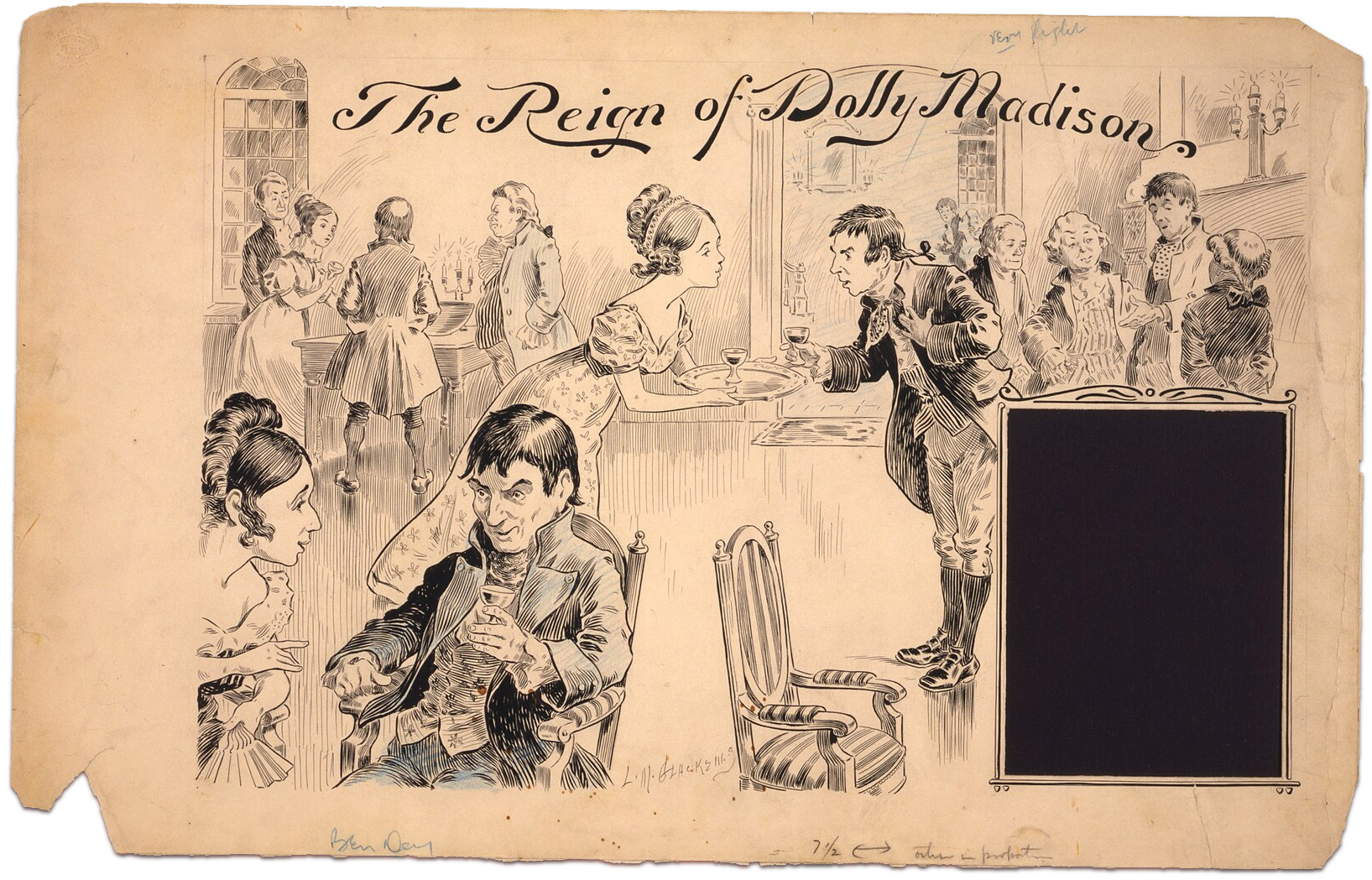
The “unofficial sphere” of women and social events also served deeper social and psychological purposes. Congressmen might rail at each other in the halls of government, dueling and fighting in the streets, but at Mrs. Madison’s squeezes they had to behave. Consequently, the lawmakers got to know each other as human beings. Women in political families forged social relationships across the aisle and worked together on various charity and patronage projects. It was hard to cast one’s political opponent as the embodiment of evil if you shared a drink with him and if your wives and families socialized with each other regularly. Washington lawmakers began to understand that, even though someone might disagree about a political issue, they could still have the public good at heart. By being in company together on Dolley’s common ground, men could begin to build their own common ground.
Bit by bit, under Dolley Madison’s watchful eye, members of the government began building a ruling class and shoring up what would become a two-party system, a hallmark of our democracy. Before the word, let alone the concept, of bipartisanship entered American politics, Dolley Madison, like a master politician, understood that working together had to be part of the system. These early leaders were learning how to collaborate, how to be prudent rulers when they were in power, and how to be an informed dissenter when they were not. They discovered ways they could foster their own political and party identities without tearing the nation apart.
These are the skills that would prove to be crucial in later decades when the United States became a modern nation, a power player in the world. By the 1820s, the founding men’s experiment in “pure republicanism” had given way to an American democracy with two parties and a strengthening federal government. That this transition happened smoothly in the new capital city was thanks to Dolley’s efforts to create spaces and opportunities to politic in strikingly modern ways.
The flaw in the founders’ plans was to imagine that political business should take place only in the official sphere. The “official sphere” encompasses political decisions and actions. Official spheres are public; think of press releases and congressional sessions. The unofficial sphere is about the process of politics and is often situated in more private spaces. Serious consideration of Dolley Madison’s efforts demonstrate that the healthiest political system must have a place where politicians can think creatively about political solutions and to see each other as human beings.

Check out the lesson on Substack to be part of the discussion. Share your views, respond to others, and help deepen our understanding.
View on Substack