Lesson #
52
• FROM
Dwight D. Eisenhower
“He hated and despised the smallness and pettiness of everyday politics,” Dwight D. Eisenhower’s press secretary once said of him.
That remained true throughout Eisenhower’s two terms as the nation’s chief executive. Our 34th president didn’t operate like most politicians. He wasn’t interested in hyperpartisanship. He didn’t view politics as war. He knew war. And there too, in the blood and smoke of true combat, he displayed a thoughtfulness that was credited for his later success as a general and president.
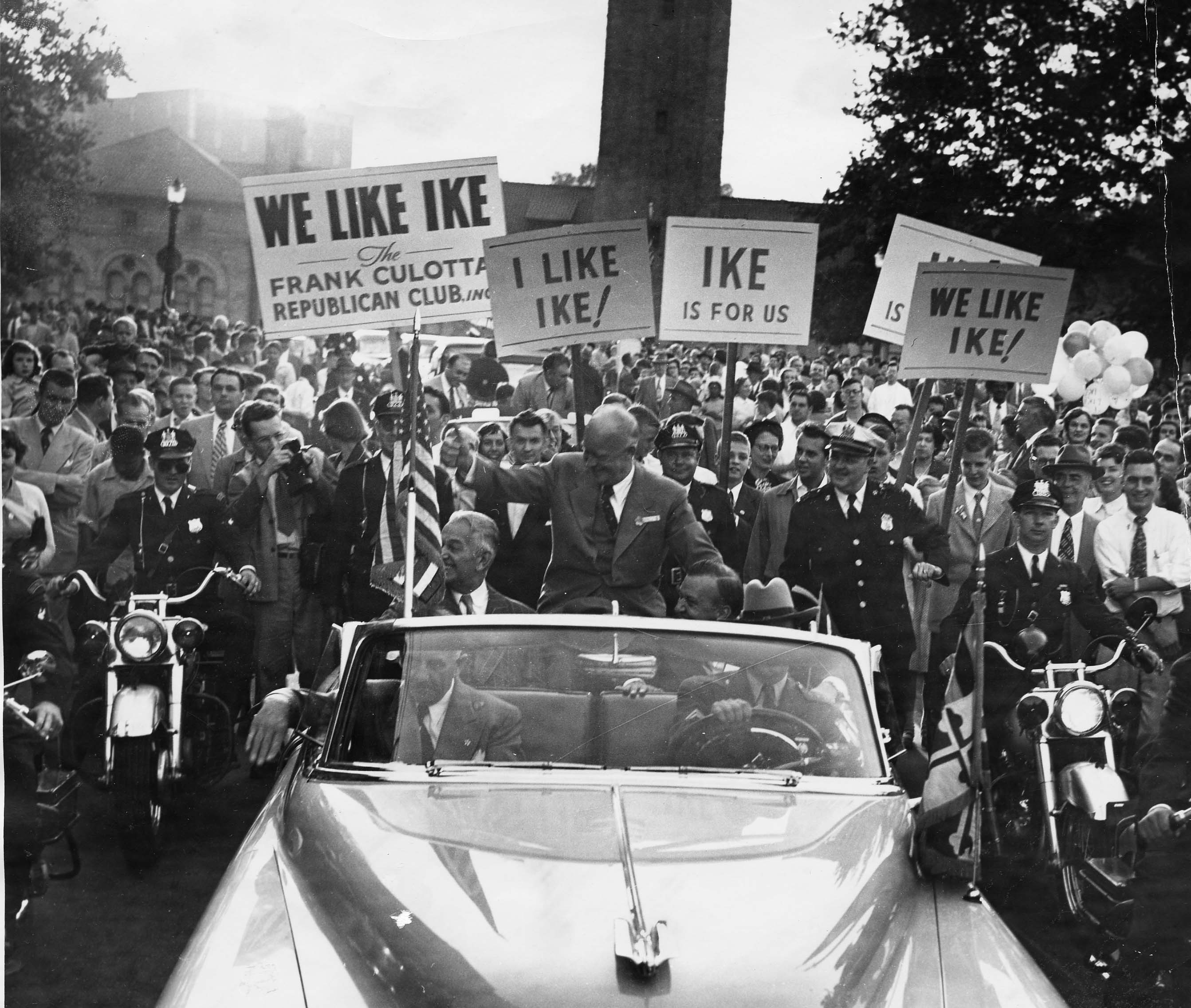
Running for president hadn’t been Eisenhower’s idea. He couldn’t imagine how it would be a good fit. He told a colleague he was grateful for everything the country had given him. But, he said, “I have no interest in politics. In fact, it nauseates me.”
His mind was changed by a sense of duty. Driven by patriotism, with a strong undergirding of humility—Americans felt comfortable calling him “Ike”—he saw that he might use his skills to help bring peace to a troubled world. He’d done it on the battlefield. Perhaps he could do it in peacetime as well. But he wasn’t going to play by the ordinary rules. Eisenhower proved that even the strongest leaders—even a revered war hero and onetime Supreme Allied Commander in Europe—can succeed by knowing when not to use that strength.
From the start Ike baffled and maddened his political advisors by failing to exhibit the usual cutthroat campaign behaviors. At the 1952 Republican nominating convention, there was a heated contest between Ike and his chief opponent, Ohio Senator Robert Taft, the son of former president William Howard Taft. While the delegates battled it out on the floor of the International Amphitheatre in Chicago, the candidates were sequestered in their hotels. When the ballots were finally tallied in Ike’s favor, he jumped up and hurried out of the hotel. The reporters circling around called after him, “Where are you going?”
He called back, “Where am I going? I’m going across the street and say hello to Mr. Taft. I just called him and asked if I could come over.”
“Collaboration was his secret weapon in the White House”
It’s unknown what was said between the bitter rivals, but they soon walked out together arm in arm in a show of party unity. This was Ike’s special nature at work—his ability to bring people along with him through soft skills, not demands or threats. He and Taft would never have a warm relationship, and they locked horns occasionally in the early years of Ike’s presidency. But when Taft died suddenly from a cerebral hemorrhage, Ike openly grieved the loss of a man he hailed as a patriot and considered a close colleague and even a friend.
Ike’s greatest gift was his ability to channel the spirit of the country he served. He was neither glib nor callous. Preparing for his first inaugural address, he agonized over how he could touch the American people in their hearts. He struggled to find the words that would express a genuine common hope for the future. He didn’t like lofty sentiments—they always felt insincere to him. What could he say? Still wrestling with his speech on the morning of the inauguration, he was sitting in church next to Mamie when he had an inspiration. He thought of the deep faith instilled by his mother in their distant homestead in Abilene, Kansas. He thought of the faith that had guided him and given him courage during the war. So, before he began his inaugural address, Ike asked Americans to bow their heads and join him in prayer.
“Give us, we pray, the power to discern clearly right from wrong, and allow all our words and actions to be governed thereby, and by the laws of this land. Especially we pray that our concern shall be for all the people regardless of station, race, or calling.
“May cooperation be permitted and be the mutual aim of those who, under the concepts of our Constitution, hold to differing political faiths; so that all may work for the good of our beloved country and Thy glory. Amen.”
That spirit of cooperation wasn’t just lip service. Ike really meant it. Collaboration was his secret weapon in the White House, especially when he faced a rival Congress. Two Democratic powerhouses were running the show: Speaker of the House Sam Rayburn and Senate Majority Leader Lyndon Johnson. The way Ike saw it, he had enough problems dealing with an actual Cold War with the Soviet Union. He didn’t need one with Congress too. So, once a month or so, he invited Rayburn and Johnson to his personal quarters in the White House where they would have drinks and canapés and talk shop. They made a pact, which Johnson cemented, saying, “Mr. President, when I agree with you, I’ll come tell you. I’ll disagree with you with dignity and decency, and I won’t talk about your dog or your boy.”
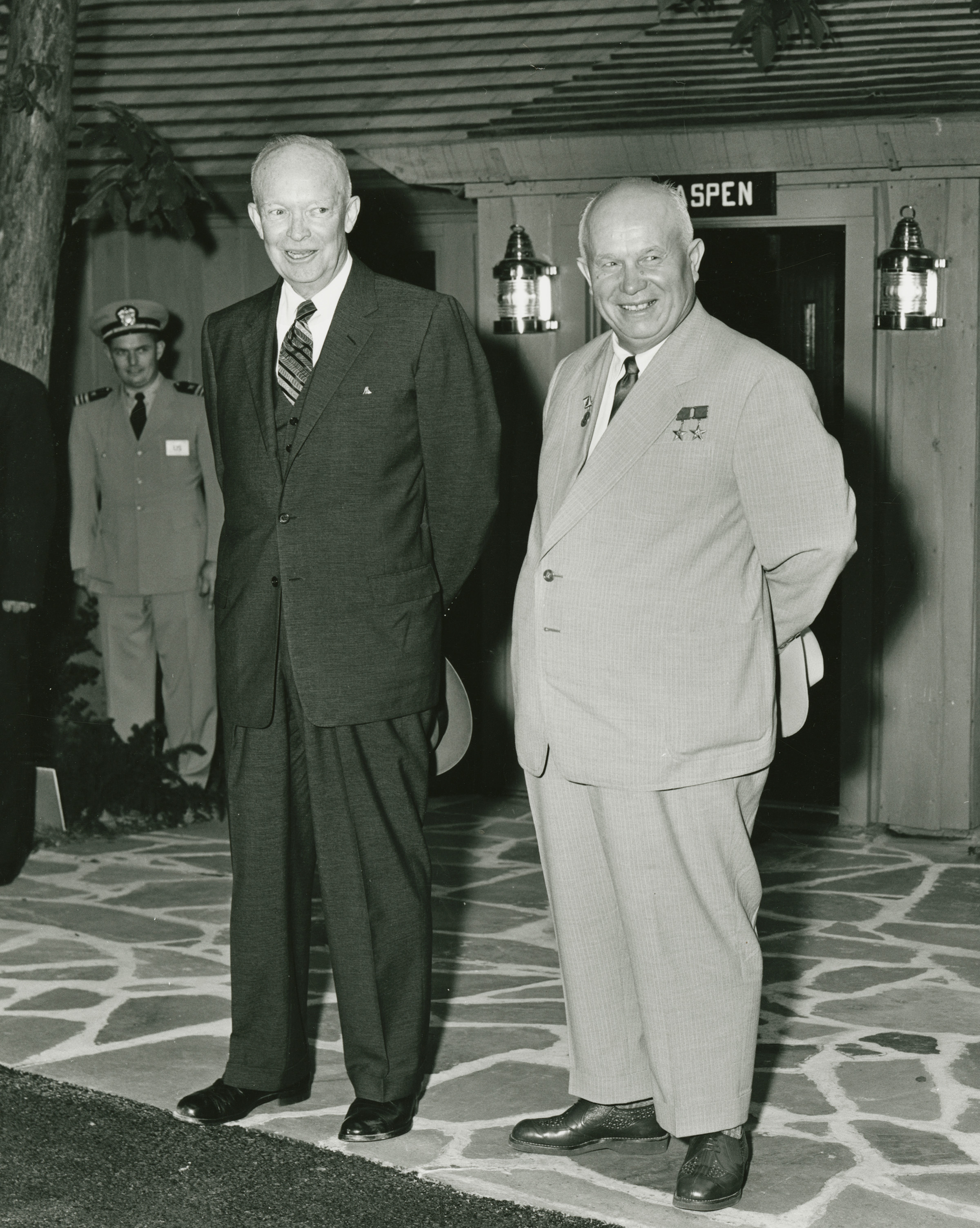
Ike even attempted to reach out to the Soviet leader, Nikita Khrushchev, in hopes of reducing the Cold War threat. Khrushchev was a party man through and through, a dangerous enemy, ideologically crazed and without scruples. Yet Eisenhower attempted to bring him around to the dangers of a nuclear standoff. At the Geneva Summit in 1955, he led Khrushchev to a startling confession about the mutual danger of radioactive fallout. “I understand completely, Mr. President,” Khrushchev said solemnly. “We get your dust, you get our dust, the winds blow around the world and nobody’s safe.” Eisenhower even invited Khrushchev to visit the United States and tour the country, which Khrushchev did for nearly two weeks.
Despite Eisenhower’s efforts, Khrushchev remained an immovable enemy. But Ike never stopped trying. His goal was the rescue of humanity itself. From his first moment in office, he saw himself as a guardian of a new era. He didn’t want to be just a warrior. As he said in his famed 1953 address, “Every gun that is made, every warship launched, every rocket fired signifies, in the final sense, a theft from those who hunger and are not fed, those who are cold and are not clothed.” In office, the “Old Man” found his place as a peacemaker.
Eisenhower’s conciliatory style did not succeed in every instance. While he deployed federal troops to Little Rock to enforce school desegregation, he missed other opportunities to more forcefully advance civil rights. Many people also criticized Eisenhower for not using his immense popularity and prestige to directly confront Joseph McCarthy. Privately, Eisenhower found the senator’s reckless pursuit of alleged Communists deplorable, and agonized over the ruination of the lives and livelihoods of countless Americans. Yet instead of speaking out forcefully against McCarthy, Eisenhower chose to stay out of the political fray, and his silence might have allowed McCarthy’s crusade to thrive.

Yet Eisenhower’s approach also yielded notable successes. He negotiated an armistice in Korea that kept the Cold War cold, strengthened the country’s alliances, created the Interstate Highway System, established NASA, and oversaw a period of middle-class growth and prosperity. Eisenhower left office with his approval at nearly 60 percent; after eight years in the White House, Americans still liked Ike.
It’s ironic that Eisenhower, a man who had commanded forces on the most brutal fields of battle, would use the tools of soft power—negotiation, collaboration, modesty—when he became president. But to those who knew him well, it was completely understandable. This was the man who had received the greatest accolades for his role in the Allied victory in World War II, yet said, “Humility must always be the portion of any man who receives acclaim earned in the blood of his followers and the sacrifices of his friends.”
“Give us, we pray, the power to discern clearly right from wrong”
- Dwight D. Eisenhower
Check out the lesson on Substack to be part of the discussion. Share your views, respond to others, and help deepen our understanding.
View on Substack