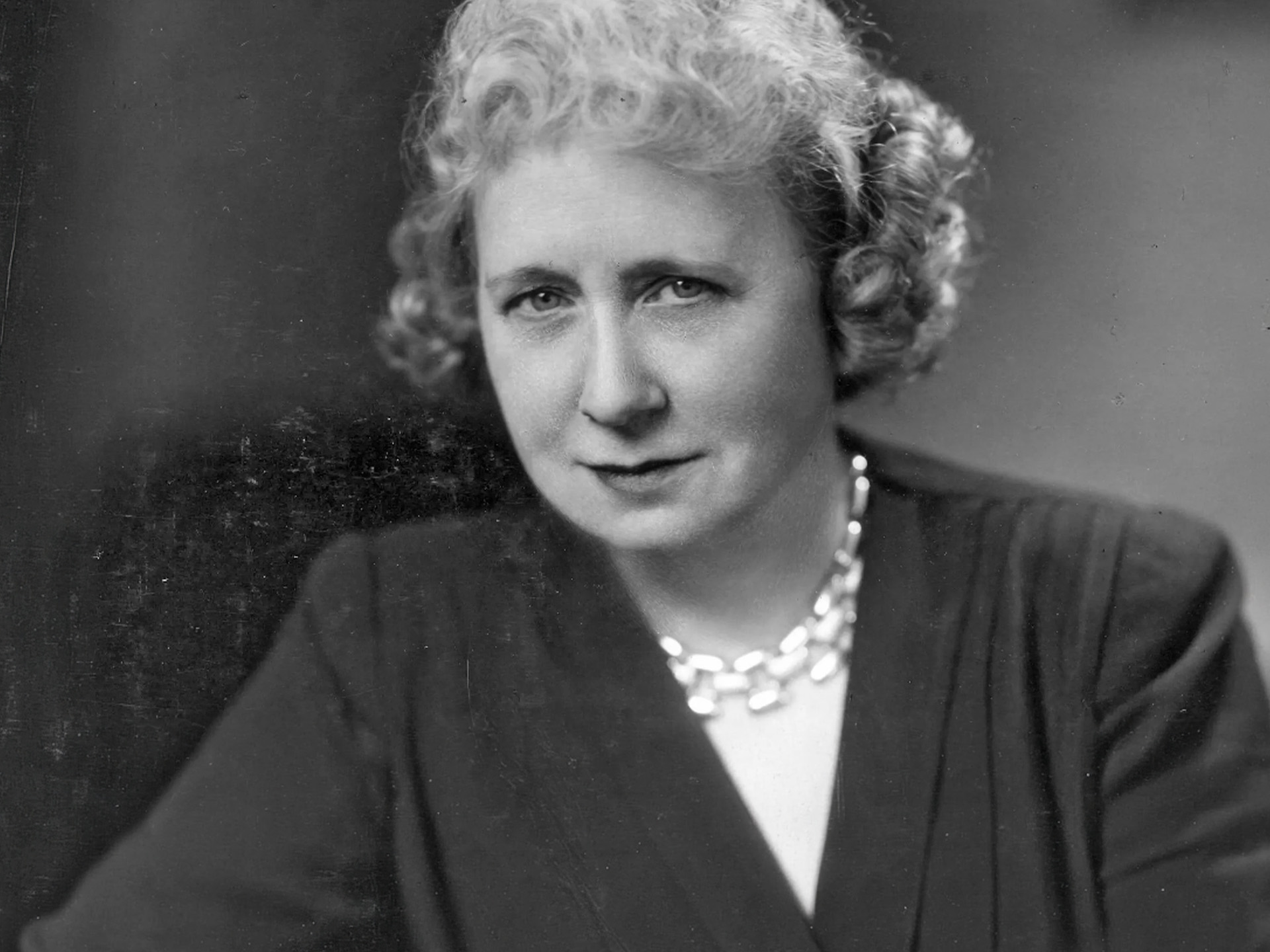
Mamie Doud Eisenhower, first lady from 1953 to 1961, brought to that role an outgoing personality and a strong sense of who she was and how things should be done. She was well-liked and admired; long after she left the White House her name continued to appear on Good Housekeeping magazine’s annual list of the ten most admired women in the world. During the 1950s, her “Mamie Bangs” hairdo and love of “Mamie Pink” in clothing and décor became part of popular culture. On a deeper level, she connected with the American public, projecting an image of the friend next door who wanted what millions yearned for -- “normal” times after the economic depression of the 1930s and war years of the 1940s. Mamie was very much in step with what people wanted for themselves and expected from her as first lady. She was a perfect fit for the era.
Born in Iowa in 1896, Mamie Eisenhower spent most of her childhood in Colorado. Her family was well-to-do, and this was reflected in Mamie’s upbringing. Like many girls of her social class, her formal education ended with a year at a finishing school where etiquette and the social graces were emphasized. From her mother, she learned the intricacies of running a household and overseeing the family budget. It was assumed that Mamie, who could not cook but could play the piano, would marry someone within her social circle and manage a home staffed with maids, a cook, and other help.
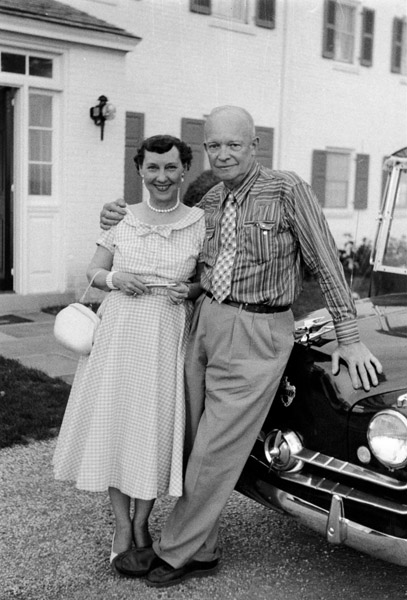
Those expectations were upended in 1915 when Mamie met Army lieutenant Dwight D. “Ike” Eisenhower at Fort Sam Houston, Texas, while her family was wintering in San Antonio. He later wrote that she had “a saucy look … and attitude.” He was smitten. So was she, saying that he was “the handsomest man” she had ever seen. She did not care that Ike’s Army pay would not support her accustomed lifestyle. They married on July 1, 1916. Mamie became a military wife. Their first home, at Fort Sam Houston, consisted of two rooms with furniture purchased from wedding money. During the 1920s and 1930s, Ike was assigned to several Army posts in the United States. Usually the couple lived on post, but when Ike (by then a colonel) was on General Douglas MacArthur’s staff in Washington, D.C., the Eisenhowers had an apartment. Between World War I and World War II, they also lived overseas when Eisenhower was assigned to Paris, then Panama, and finally the Philippines. At each place, Mamie created a home for her family and a place that welcomed friends and acquaintances.
In military culture, wives considered themselves partners in their husbands’ careers. How a woman conducted herself, ran the household, and managed the children reflected on her husband. Mamie told a group of editors and writers in 1952: “As a soldier’s wife I learned early in life that pride in personal appearance is not a superficial thing. It rates high on every officer’s efficiency report---and his family is part of the report.” Mamie believed that everything she did mattered, whether it was raising funds for a post hospital in Panama or helping redecorate the officers’ club at Fort Lewis, Washington. A woman could not assure her husband’s promotions in rank, but military wives like Mamie understood that “with our career, a wife plays a big part.” When her husband became President, Mamie carried this outlook and her experiences into the White House. She had no doubt that she had a significant part to play as first lady.
“With our career, a wife plays a big part.”
- Mamie Eisenhower
From the early days of their married life, the Eisenhowers entertained at home, wherever it was. While in Paris, their apartment became a second home, “Club Eisenhower,” to military friends and other Americans visiting Europe. In the Philippines, the couple mixed with the highest echelons of government officials and social elite, and after World War II, when General Eisenhower headed the North Atlantic Treaty Organization (NATO) in Belgium, the Eisenhowers met, entertained, or were the guests of every royal family and head of government in Europe. Mamie felt that she was well prepared to act as White House hostess.
With the war years in the past and the almost four-year renovation of the White House completed during the Truman administration, Mamie brought a sparkle to the White House. A good part of her success as a hostess was that she genuinely liked people and took an interest in them. Receiving lines sometimes moved at a crawl because the first lady insisted on speaking to every person in the line, rather than offering a quick greeting. “She could charm the socks off anybody she met,” said one observer. During her eight years as first lady, she welcomed thousands of visitors to the Executive Mansion. They were members of women’s groups, military and charitable organizations, and youth groups. There were also thirty-seven foreign heads of state, as well as official envoys representing their respective countries, and other figures important in shaping world events. Mamie would not have called her endeavors soft diplomacy, but under her direction, the White House was an attractive, welcoming symbol of the United States after it emerged from World War II as a superpower.
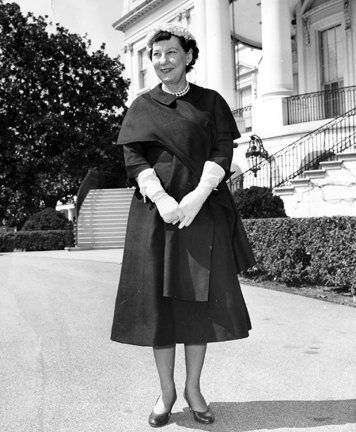
She refused to turn White House events into “a political issue.” Her guest lists were nonpartisan, bringing together people of varied social and political beliefs, including both supporters and critics of the Eisenhower administration. Everyone entering the Executive Mansion was greeted as a valued guest. Her role, as she saw it, was to be a nonpolitical first lady representing all Americans. Privately she had opinions, but she did not make public statements or involve herself in West Wing discussions of policy as had former first lady Eleanor Roosevelt or future first ladies Rosalynn Carter and Hillary Clinton.
The public saw Mamie on television and on the campaign trail. They read about her in newspaper and magazine stories. People felt a connection. Their life experiences might be vastly different, but there was a sense that they knew her. They felt a shared experience in supporting military men and women during World War II and the Korean War. Housewives could relate to the ways Mamie stretched the family budget. She may have lived in the White House, but the government allowance for expenses did not pay for everything. Mrs. Eisenhower clipped store coupons; insisted that leftovers from one family meal be used in another, usually in casseroles; and although she had designer hats and dresses, she also shopped at J.C. Penney. Like so many other Americans, she wanted to own a home, something she and Ike had never been able to have. Young couples beginning families and older couples with children and grandchildren could identify with Mamie’s devotion to her husband, son, and grandchildren. It was easy for Americans to see a little of themselves in the first lady. She was a reassuring presence while reflecting in so many ways life in the 1950s.
She brought to the White House her own style, a sense of duty honed as a military wife, and an effervescent personality. All the while, she refused to allow others to tell her who she was or what she should be. There were no public relations advisors or media consultants shaping her public image. She had the strength of character to define herself and her role. At the time of Mrs. Eisenhower’s death in 1979, journalist Marian Christy wrote admiringly that Mamie “had the guts” to be herself.
“She refused to allow others to tell her who she was or what she should be.”
Check out the lesson on Substack to be part of the discussion. Share your views, respond to others, and help deepen our understanding.
View on Substack