Lesson #
36
• FROM
Theodore Roosevelt
National elections in the United States are determined by the culture and its conflicts; by the social and economic conditions existent at the time of the election; by the candidates and their campaigns; and by the coverage of them in the media. But when the dust of a Presidential election clears, the voters have given the winner enormous power over one of most elementary questions of our democracy: who gets to be included in “We the People?”
The best presidents have defined “We the People” in a way that expands the idea of who counts in our country. They committed—each in their own way, given the options before them and the constraints they faced—to see “We the People” expand from the few to the many, and in so doing to honor the promise of our Constitution to form a more perfect union.

Theodore Roosevelt was that kind of president. His legacy stands on several pillars— conservation of our natural treasures; anti-corruption efforts in government; strengthening a merit-based civil service to replace the spoils system of political patronage; the development of a world-class Navy; anti-monopolistic regulations on the private sector; and vigorous support for competitive workplaces to keep workers safe and more fairly paid. He saw government as an engine of progress, rather than just a collection of powerful special interests.
And he believed, as I do, that in a capitalist system that is constantly evolving with new discoveries in a world that’s increasingly interdependent, only our government, with all its faults, has the ability to do what needs to be done. Only our government, aptly described by an earlier President as being of the people, by the people, and for the people, can ensure that everybody counts; everybody has a chance; and we all do better when we work together. “We the People” leaves nobody out who’s willing to live lawfully and work hard.
***
The turn of the 20th century saw the growing concentration of big business; the migration of working people from farms to cities; and the long hours, low pay, and dangerous conditions that men, women, and child workers faced in factories. In response, the Progressive movement expanded the government’s power to preserve competition from monopoly, to promote basic safeguards for labor—especially for women and children—to provide for the poor, and to protect our natural resources from plunder. Roosevelt preserved great tracts of land from development and saved the buffalo when it was on the brink of extinction. And he took the historically significant step of inviting Booker T. Washington to the White House to dine with him and his family.
Roosevelt and the Progressives who supported him believed that the best use of our political power, brainpower, and commercial, natural, and industrial power was to give all people the chance to build better life stories and save something for the future. In his first address to Congress after becoming President when President McKinley was assassinated by an anarchist, Roosevelt said, “If the farmer and the wage-worker are well off, it is absolutely certain that all others will be well off too.”
“If the farmer and the wage-worker are well off, it is absolutely certain that all others will be well off too.”
- Theodore Roosevelt
Throughout his presidency he championed the worker over powerful interests, particularly when it came to the health and wellbeing of ordinary people on the job. “The number of accidents which result in the death or crippling of wageworkers…is simply appalling,” Roosevelt said near the end of his tenure. “No academic theory about ‘freedom of contract’ or ‘constitutional liberty to contract’ should be permitted to interfere with [worker safety and compensation] and similar movements.”
But unlike the Populists like William Jennings Bryan, who lost the 1900 election to McKinley on a pledge to take a buzzsaw to private interests in the name of the common man and woman, Roosevelt was practical about reform and absolutely hated class warfare. He declared, “…it cannot too often be pointed out that to strike with ignorant violence at the interests of one set of men almost inevitably endangers the interests of all…in the long run, we shall go up or down together.”
Still, he understood that hard times fall differently on those nearer the bottom of the economic ladder. In an economic disaster, he said, “The capitalist may be shorn of his luxuries; but the wage-worker may be deprived of even bare necessities.” Such hard times were still front and center in most Americans’ minds less than a decade after the devastating Panic of 1893.
Yet while Roosevelt knew these same Americans wanted a forward-looking government, they didn’t want to throw the baby out with the bathwater. In his 1904 address to Congress shortly after winning re-election, Roosevelt said, “The people have emphatically expressed…their desire that these principles be kept substantially unchanged, although, of course, applied in a progressive spirit to meet changing conditions.” Roosevelt knew that we could only keep faith with the past by continually making a new covenant with the future, preserving what is enduring but adapting our nation time and again to what is new.
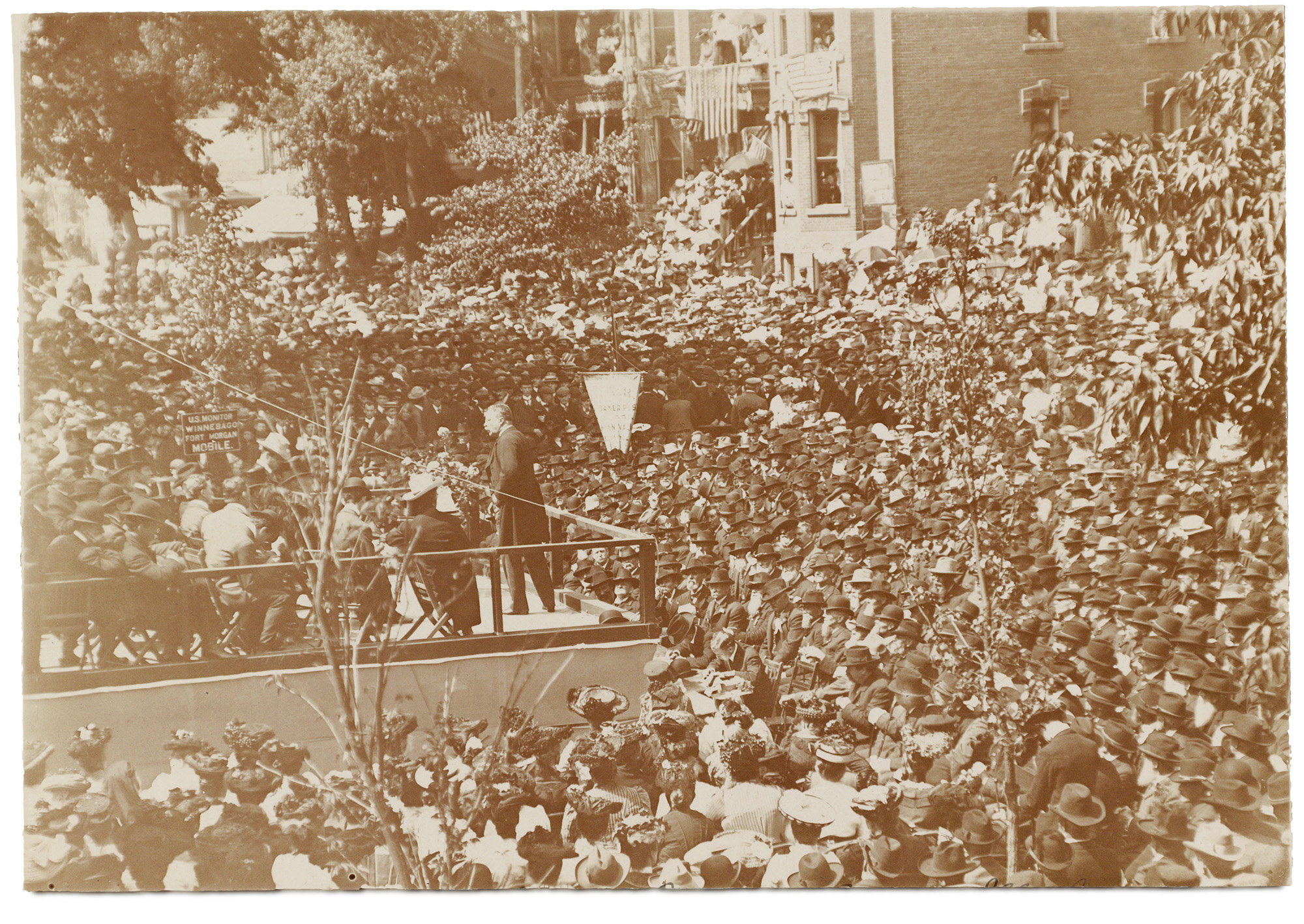
President Roosevelt was a force at home and abroad—expanding not only “We the People,” but also America’s sphere of influence. He understood at the start of what has been called the American Century, that the United States simply could not engage with the world only when convenient. He helped end the Russo-Japanese War, earning the first Nobel Peace Prize awarded to an American, and foresaw the world’s growing interdependence in which borders would be more porous and isolationism would only give despots free rein over their citizens.
At the far end of that same American Century, I was elected to a presidency that, due in no small measure to following the lead of Theodore Roosevelt, helped the U.S. adapt and grow to meet challenges unimaginable to many of Roosevelt’s contemporaries, while consistently striving to enlarge and expand the definition of “We the People” here at home.
But Roosevelt’s definition of “We the People” did have real limits—limits rooted in racial and gender beliefs that, even by the standards of his own time, left much to be desired and set
the stage for the struggles of the century to come. He supported women’s suffrage but espoused traditional views on women’s roles. He attended minstrel shows and, though he showed respect to certain individual leaders like Booker T. Washington, considered Black people as a whole inferior. He regarded Native Americans as savages. Roosevelt was also a committed eugenicist, arguing that “the inescapable duty of the good citizen of the right type is to leave his or her blood behind him in the world; and that we have no business to permit the perpetuation of citizens of the wrong type.”
His example reminds us that even the most expansive vision of inclusion can be undermined by a failure to believe in the equal dignity of all people. It also reminds us of how much work there is still to be done. Theodore Roosevelt expanded the circle of “We the People” further than virtually any president before him—but not nearly far enough. That tension is not a footnote to his legacy. It is the lesson. His limited vision of “We the People,” shared by too many of his fellow citizens, had terrible consequences: the displacement of Native Americans, Jim Crow entrenched in the South and prevalent elsewhere, and women still without the vote nationwide. For all he accomplished, Roosevelt left much unfinished business.
Every generation inherits not only the progress, but also the unfinished business of our ancestors, and every generation must decide whether to widen the circle or let it close. I’ve spent my life believing it must widen—that addition still works better than subtraction, and multiplication is much better than division. So did Roosevelt, imperfectly and incompletely. And that is why I believe we’d do well to keep the core lesson of Theodore Roosevelt’s presidency in mind as we struggle to live up to our founders’ charge to create a more perfect union.
The question is not whether we will fall short. We will. The question is whether we will keep trying. In that task, it is not only the President who has a job to do. We all have a part to play. Each of us matters. You aren’t just one of “the People.” You help to influence who “We” is.
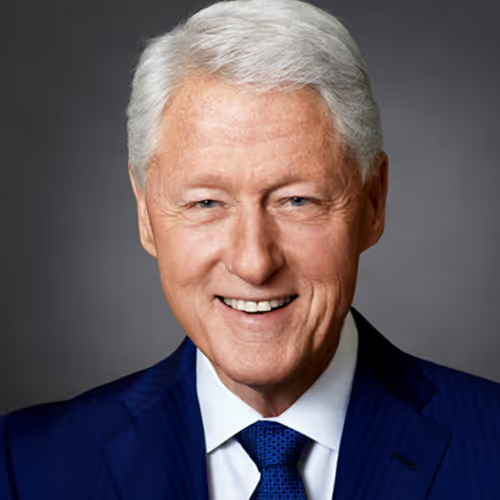
“You aren’t just one of ‘the People.’ You help to influence who ‘We’ is.”- President William Jefferson Clinton
Check out the lesson on Substack to be part of the discussion. Share your views, respond to others, and help deepen our understanding.
View on Substack