Herbert Hoover died in 1964, at the age of ninety. He had lived a phenomenally productive life, including more than half a century in one form or another of public service. It was a record that in sheer scope and duration may be without parallel in American history.
Born in Iowa and orphaned before he was ten, by 1914 Hoover was a globally acclaimed mining engineer living in London. When World War I broke out that year, he became an international hero by creating an unprecedented relief commission that delivered food for more than four years to the entire civilian population of German-occupied Belgium, which was under constant threat of starvation. Belgium was just the beginning. Between 1914 and 1923, as Europeans endured war and revolution, Hoover directed, financed, or assisted a multitude of relief endeavors in more than twenty nations—an effort without parallel in the history of mankind. Tens of millions of people owed their lives to his exertions. It was later said that Hoover was responsible for saving more lives than any other person in history.

During the 1920s, as a hyperactive secretary of commerce under Presidents Warren Harding and Calvin Coolidge, he became one of the three or four most influential men in the U.S. government. Rejecting both laissez-faire economics and Old World socialism, he called his political philosophy “American individualism.” Later he would term it “historic liberalism.”
In 1928, the Great Humanitarian, as admirers called him, was elected President of the United States in a landslide—without ever having held an elective public office. Once inaugurated, he pursued a reform agenda. And when, in October 1929, the stock market crashed, he took steps that changed the course of American history.
Though Hoover is often criticized for failing to meet the moment, he in fact boldly intervened on a scale unmatched by any previous President. Convinced that the country’s difficulties were fundamentally “psychological,” he dominated the public stage with a flourish of activism. Instead of allowing the business downturn to run its course, Hoover confidently, deliberately, and self-consciously abandoned the principle of political noninterference with the business cycle. In effect, Hoover was practicing a kind of psychotherapy, designed to restore the nation’s badly shaken confidence. Confidence—this to him was the key to renewing prosperity.
“It was later said that Hoover was responsible for saving more lives than any other person in history.”
Hoover’s early recovery program of what he called “cooperation outside of government” won widespread public approval. In early 1930 the stock market recovered much of the ground it had lost during the previous autumn. But then—as would happen repeatedly in the next three years—just when Hoover thought he had restored economic equilibrium, unexpected turbulence arose. In June 1930 Congress enacted and Hoover approved the highly protectionist Smoot-Hawley tariff. Just how destructive this measure proved to be remains a subject of debate. But psychologically its impending enactment appeared to upset the edifice of confidence that Hoover had been building. As the congressional struggle over the tariff reached a climax, the stock market tumbled anew.
Then, in the summer of 1930, across much of the Midwest and South, the worst drought yet recorded in American history ravaged the crops of thirty states. Millions of acres of planted fields were ruined. Farm income in the devastated region fell by 25 percent.
In 1931 came new manifestations of what Hoover called “frozen confidence” among investors and bank depositors. A deepening financial crisis in Europe sent shock waves across the United States, leading to the failure of hundreds of American banks and a growing sense of economic paralysis.
In December 1931 Hoover dramatically asked Congress to establish a Reconstruction Finance Corporation, with broad power to lend money directly to beleaguered banks and other commercial institutions. Never before had a peacetime president proposed to intervene so massively in the workings of private enterprise. Not bankers, not captains of industry, but the government itself would now attempt to lubricate the nation’s “credit channels” and make the wheels of commerce turn again. Congress eventually authorized this extraordinary measure, along with others requested by Hoover. For a time in mid- and late 1932 it appeared that the American economy was slowly beginning to mend.
For Hoover the signs of improvement came too late. For nearly three years he had striven without stint to induce the American people to shake off the economic doldrums. Nevertheless, the economy had floundered, thanks at least in part (some scholars now believe) to something neither he nor virtually anyone else at the time quite understood: the fatal misjudgments and errors of the Federal Reserve Board. Soon—too soon—he faced a frightened electorate and a charismatic opponent: Franklin D. Roosevelt.
As he campaigned unsuccessfully for reelection, Hoover refused to abandon his political philosophy. He reaffirmed his faith in “historic liberalism” and “self-government by the people outside of the Government” and lashed out at the collectivistic regimentation that he sensed would be at the heart of Roosevelt’s proposed New Deal. In a climactic campaign address, Hoover warned that the election was more than a contest between two men or two parties. It was “a contest between two philosophies of government,” and its outcome would determine the nation’s course for “over a century to come.” For the rest of his life he regarded this as one of his most prophetic utterances.
In 1933 Hoover left office a virtual pariah. And then something remarkable happened. Instead of retreating quietly into obscurity, he reentered the political fray, behaving as an ideological warrior more persistently and more fervently than any other former president in our history. Upholding the banner of “true liberalism,” Hoover undertook what he called a “crusade against collectivism” and became a relentless critic of the New Deal. Undaunted by political adversity, for the next thirty years he persevered—in speeches, books, and ambitious endeavors like the Hoover Institution on War, Revolution and Peace—as a man with a mission, seeking not just the recovery of his reputation but the political, intellectual, and spiritual rescue of a nation that he believed had been led astray. In the process he regained the respect of many who had previously despised him and demonstrated that leaders can lose power without losing influence.
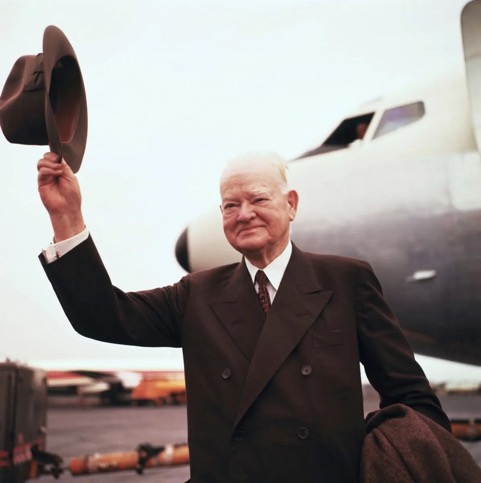
In the 1930s and 1940s, both Hoover and his arch-rival Roosevelt knew that they were engaged in a mighty contest for the American mind and political soul. What had gone wrong in America since the Crash of 1929? Was the Great Depression a crisis of unregulated capitalism, a product of Hoover’s mismanagement, or a catastrophe brought on by uncontrollable events abroad? Did the traditional “American System” of limited government, private enterprise, and volunteerism that he extolled fail disastrously in 1929-1932, or did his successor in the White House launch America on a dangerous and unnecessary spiral toward socialism? Which competing narrative of recent history would prove more persuasive to anxious voters? As Hoover foresaw in 1932, the answers to these questions would shape the nation’s course for a century to come.
In the large sweep of twentieth-century American history, Hoover the humanitarian-philanthropist and unflagging anti-New Dealer contributed mightily to the reinvigoration of the philosophy of “historic liberalism” and its critique of unrestrained statism, a critique that remains an important part of our political discourse. Thanks in considerable measure to his indefatigable ex-presidency, his embattled presidency has never quite faded away.
Check out the lesson on Substack to be part of the discussion. Share your views, respond to others, and help deepen our understanding.
View on Substack