In eighteenth-century America, distance still made a huge difference. There were no cellphones, no internet, no instant forms of communication. There were, however, letters, which often took weeks or months to arrive. The act of writing a letter was therefore a more deliberative process than composing an email, more like writing a speech than having a chat, more a projection of your deepest thoughts than your immediate impulses.
This distinction between now and then is essential background as we enter their lost world and attempt to grasp the full meaning of the roughly 1,200 letters that John and Abigail Adams exchanged during the founding era. For, in truth, they were writing to us as well as to each other.
Our story begins in June of 1776, when John wrote these words to Abigail: “I have now purchased a Folio Book in the first page of which … I am writing this letter, and intend to write all my letters to you in it, from this time forward.” He urged Abigail to do the same thing, claiming that “I really think that your letters are much better … than mine.” (Many historians have tended to agree with John’s judgment.)
When John wrote these words, he presumed that he and Abigail were crossing the Rubicon together, living through the decisive moment in American history and they had both an opportunity and obligation to record their thoughts for future generations, which is to say, us.
On one score John was right. He and Abigail both believed that American independence was inevitable. But, as he already knew, they were not on the same page when it came to the political agenda of an independent America. A letter that Abigail began writing a few months earlier in March made that clear. When John received her letter in early April, he found what he called “my saucy wife” lived up to her reputation.
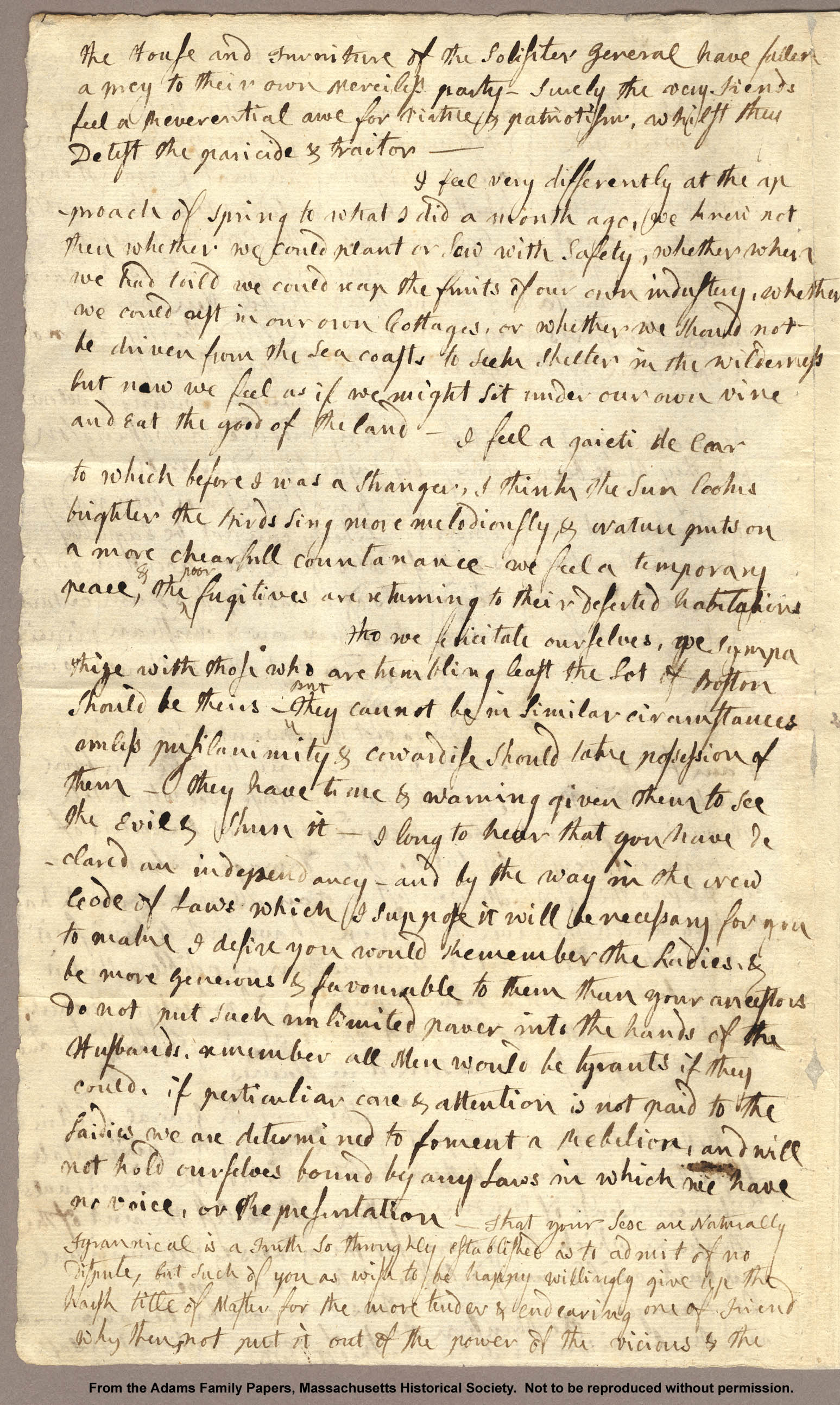
“And, by the way,” she began, in what has become the most famous letter in the entire Adams correspondence, “in the new Code of Laws which I suppose it will be necessary for you to make I desire you would Remember the Ladies, and be more generous and favourable to them than your ancestors. Do not put such unlimited power into the hands of the Husbands. Remember all Men would be tyrants if they could. If particular care and attention is not paid to the Ladies we are determined to foment a Rebellion, and will not hold ourselves bound by any Laws in which we have no voice or Representation.”
John bantered back, claiming “as to your extraordinary Code of Laws, I cannot but laugh,” adding that he had no desire to exchange, what he called the tyranny of George III for “the despotism of the petticoat.”
Abigail never wavered. First, she threatened that she and her closest friend, Mercy Otis Warren, intended to file a petition in the Boston press, claiming that they were being taxed without their consent. Then she embraced her own “sauciness” and delivered her ultimate threat. “But you must remember that Arbitrary power is like most things which are very hard…and notwithstanding all your wise Laws and Maxims we have it in our power, not only to free ourselves, but to subdue our Masters, and without violence throw both your natural and legal authority at our feet.”
“We will not hold ourselves bound by any laws in which we have no voice or representation.”
Abigail Adams
She was not only arguing that women had the right to vote, but also that all presumptions of male supremacy (i.e. patriarchy) needed to die a natural death. Both arguments were far ahead of their time. White women did not get the vote in national elections until 1920. As for patriarchy, though on the political defensive in most blue states, it is still alive and well in significant segments of the male population.
What do you do if you are a highly intelligent New England woman with ardent political convictions about gender equality that you realize will never come into existence during your lifetime, or even for your female descendants? This was Abigail’s dilemma. From the perspective of outspoken feminists now, the answer to the dilemma is clear. Abigail had the opportunity to become the leader of the feminist movement in America, this before the word “feminism” had yet to appear in the dictionary.
That option never occurred to Abigail. She inhabited an eighteenth-century world in which her deepest sense of fulfillment came from performing her role as a wife and mother. Even the extraordinary statement of women’s rights came in a private letter to John, her wifely duty to make him more aware of the full implications of America’s revolutionary agenda. She threatened to go public with her convictions, but never did.
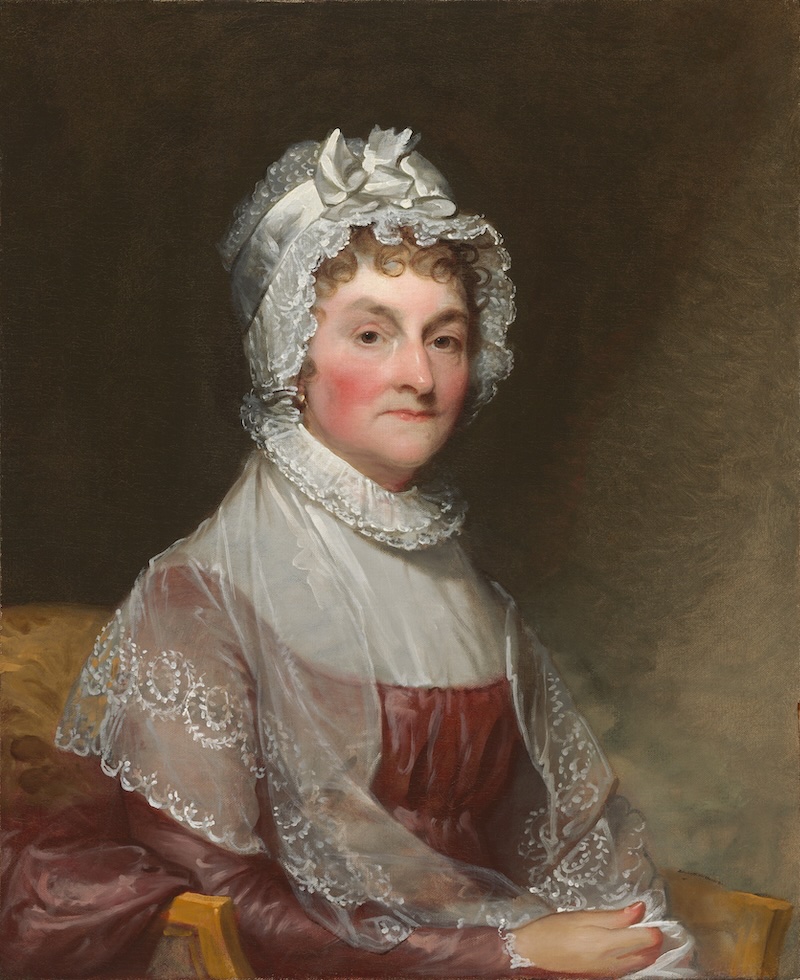
She was, to be sure, a visionary, but the vision she kept in her mind’s eye throughout her life was those moments when she and John were holding hands while walking through their field at Braintree, the four children training behind. Her only daughter, called Nabby, was groomed to become a homeschooled wife and mother. Her sons were groomed for college at Harvard.
But even in her preferred and private role as a wife, she could be disconcertingly formidable. Thomas Jefferson, who lived with the Adams family for several weeks in Paris, was taken aback by her ability to recite passages from Shakespeare while cooking supper, or apprise him of the political factions within the French court. No southern woman he had ever met could do that. During the Adams presidency, whenever John made an unpopular decision, the preferred explanation was often that his wiser, more political savvy wife was not there to advise him. No first lady until Eleanor Roosevelt exercised more political influence on her husband.
More immediately, as we begin to celebrate the 250th anniversary of American independence, no person left a clearer statement in the written record that sexual equality was a significant legacy of the American Revolution. Because the Adams correspondence was so carefully preserved, Abigail’s visionary legacy still speaks to us. And it remains visionary.

Check out the lesson on Substack to be part of the discussion. Share your views, respond to others, and help deepen our understanding.
View on Substack